From a princely emblem on the coins of Volodymyr the Great to the State Emblem of independent Ukraine, the Tryzub has travelled a long historical path. Its design has changed, and the symbol has experienced periods of obscurity and prohibition, yet it has returned to Ukrainian public life time and again.
Today, the Tryzub can be seen on state documents, military insignia, monuments, coins, clothing and jewellery. To understand why this sign has become so recognisable, it is worth tracing its history from the age of the Kyivan princes to the present day.
1. Where Does the Ukrainian Tryzub Come From?
The earliest finds of signs resembling a trident on the territory of present-day Ukraine date back to the early Middle Ages. However, not every ancient image with three prongs can automatically be considered a direct predecessor of the modern State Emblem. The princely symbols of the Rurik dynasty, known from monuments and artefacts dating from the 10th to the 13th centuries, are particularly important to the history of the Ukrainian Tryzub.
In the princely era, such signs served as personal or dynastic emblems. They were placed on coins, seals, weapons, household objects, building materials and other items. They could indicate that an object belonged to a prince, attest to his authority or identify something issued on his behalf.
The Tryzub, therefore, did not appear in the 20th century as a newly invented graphic symbol. Its historical roots reach back to the princely period of Kyivan Rus, although its modern meaning as a national emblem emerged much later.
2. The Tryzub in the Time of Kyivan Rus
The best-known princely Tryzub is associated with Volodymyr Sviatoslavych, known as Volodymyr the Great, who ruled in Kyiv from around 980 to 1015. His emblem appeared, among other places, on silver and gold coins. Their minting was one expression of the political and economic authority of the Kyivan prince.

Silver coins were among the first coins minted in Kyivan Rus. They combined an image of the prince, Christian motifs and a dynastic sign. The National Museum of the History of Ukraine describes the Tryzub on Volodymyr’s silver coins as a Rurikid emblem and notes that the coin imagery had a declarative function: it displayed the authority of the prince. See the National Museum of the History of Ukraine digital collection: Type II silver coin.
The princely emblem appeared on more than coins. It has been found on seals, rings, vessels, weapons, equipment, bricks, lead seals and other artefacts. This variety of objects shows that the sign was a practical mark of authority and ownership, not merely a decorative ornament.
It is important to remember that in the princely era the Tryzub was not a state coat of arms in the modern legal sense. It was a dynastic emblem that later became the foundation of a national state symbol.
3. Two-Pronged and Three-Pronged Emblems: Signs of a Princely Dynasty
The princely emblems of the Rurik dynasty were not fixed or identical. Different members of the dynasty used tridents, two-pronged signs and more complex variations with additional details. The design could change from one generation to the next while retaining a recognisable underlying form.
Volodymyr Sviatoslavych’s predecessors, including his father Sviatoslav Ihorovych, used a sign with two principal prongs. Under Volodymyr, the three-pronged version became prominent and eventually the best-known form. Later princes again used two-pronged emblems or their own modifications of the sign.
These differences matter: they show that a princely emblem could express both dynastic affiliation and the identity of a particular ruler. Researchers study the shape, proportions and additional details of the signs to establish their possible owners and approximate dates.
4. What Does the Tryzub Mean? The Main Theories
Despite its centuries-long history, the original meaning of the princely emblem has not been conclusively established. Researchers have proposed many interpretations of its shape. The best-known include:
- A falcon in flight. One popular interpretation sees the outline as a stylised bird with outstretched wings.
- A trident or an anchor. Other theories connect the shape with objects that have three prongs or branches.
- A sign of authority or a dynastic emblem. This interpretation is based on the context in which the Rurikid princes used the sign - on coins, seals and objects associated with power and ownership.
- Religious and cosmological interpretations. Some hypotheses link it to the idea of threefold unity, solar symbolism or ancient beliefs.
What can be regarded as established?
The use of the Tryzub as a princely emblem of the Rurik dynasty is well documented. Its exact original meaning, however, remains a subject of scholarly debate. The falcon, anchor and other interpretations should therefore not be presented as proven facts.
This uncertainty is itself part of the symbol’s history. Its meaning was shaped not only at the time of its creation but also over subsequent centuries, as different generations gave it new significance.
5. How the Princely Emblem Changed
Princely signs could differ in the number of prongs, the shape of the central element, the curves of the side elements and the presence of additional details. Some images include small crosses, circles, crescent-like elements or decorative endings.
There was no single graphic standard comparable to a modern state coat of arms. The emblem was applied to different materials and surfaces, so its appearance also depended on the technique used: striking a coin, stamping a seal, carving or branding an object.
For historians, these differences are more than variations in design. They help compare archaeological finds, identify the possible association of objects with particular princes or branches of the dynasty, and trace the spread of the symbol.
6. The Tryzub After the Decline of the Princely Tradition
As the political and heraldic systems of the medieval Rus lands changed, princely emblems gradually lost their former role. Other coats of arms became widespread in towns and territorial centres. For example, the Archangel Michael later became strongly associated with Kyiv, while Lviv became recognisable through the image of a lion.
The Tryzub did not disappear entirely from historical memory, but it ceased to serve as a general symbol of political authority in Ukrainian lands. Its historical significance would later be reinterpreted by those searching for symbols of Ukrainian statehood.
7. The Return of the Tryzub: The Ukrainian People's Republic
At the beginning of the 20th century, during the Ukrainian national revival and the revolution of 1917-1921, the question of symbols for the new state became urgent. The Central Rada established a special commission that included historians, lawyers, heraldry specialists and artists. It was chaired by Mykhailo Hrushevskyi.
Hrushevskyi initially proposed a coat of arms featuring a golden plough on a blue field, symbolising peaceful productive work. The commission considered several designs but ultimately chose the ancient princely emblem associated with Volodymyr the Great. This choice emphasised continuity between the state tradition of Kyivan Rus and the restored Ukrainian state.
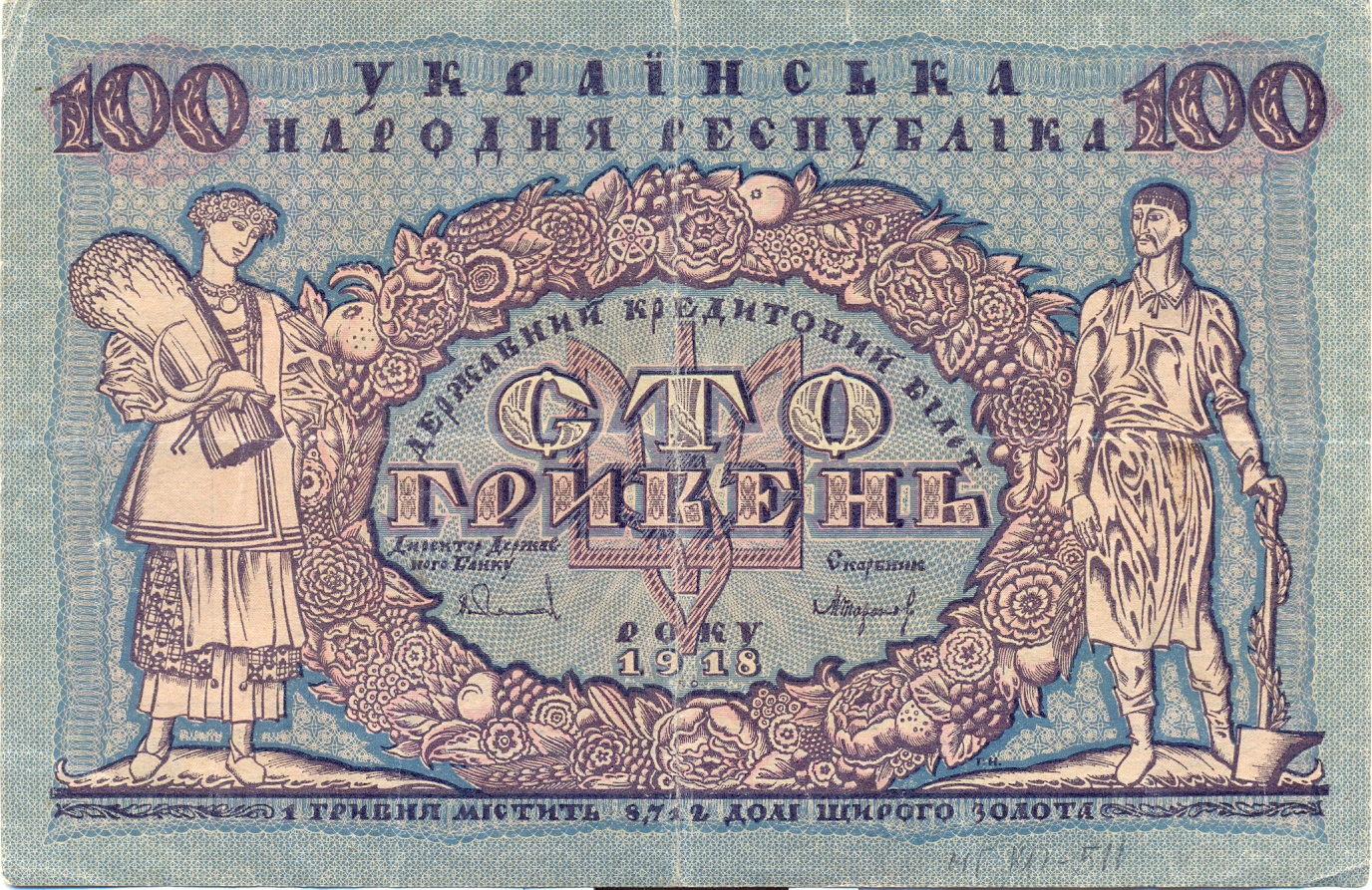
Even before its official adoption, the Tryzub appeared on the first banknote of the Ukrainian People's Republic (UPR), with a face value of 100 karbovantsi. Issued on 6 January 1918, it was designed by Heorhii Narbut. The emblem appeared inside an octagonal frame, with a cross above its central prong.
On 25 February 1918, the Small Council of the Central Rada, meeting in Korosten, adopted the sign of the Kyivan state in the time of Volodymyr the Saint as the coat of arms of the Ukrainian People's Republic. The resolution provided a verbal description rather than a finished graphic design.
8. Vasyl Krychevskyi and the Graphic Versions of the UPR Coat of Arms
On 22 March 1918, the Small Council approved a graphic design of the coat of arms created by artist Vasyl Krychevskyi. At its centre was the Tryzub, framed by an olive wreath. Krychevskyi sought to combine the ancient emblem with a modern graphic language and Ukrainian decorative motifs.

During the Ukrainian State period, heraldic work continued. On 24 November 1918, a special commission approved designs for a coat of arms and a seal prepared by Heorhii Narbut, but they were not officially adopted. Under the Directory, a version of the Tryzub without the wreath was used.
Thus, several graphic solutions and proposals existed in 1918-1919. They should be distinguished from one another: not every sketch or artistic proposal acquired the status of an official state coat of arms.
9. The Tryzub in the Liberation Movement and the Ukrainian Diaspora
After the defeat of the Ukrainian Revolution, the Tryzub did not disappear along with the institutions of the UPR. It continued to be used by the government of the UPR in exile and by Ukrainian organisations that preserved the idea of independence.
During the interwar period, the symbol acquired new graphic interpretations. The best-known is the emblem of the Organisation of Ukrainian Nationalists (OUN), in which the central prong of the Tryzub takes the form of a sword. This sign should be distinguished from the state coat of arms: it was the emblem of a particular political organisation.
The Tryzub was also used in the symbolism of the Ukrainian Insurgent Army (UPA), appearing on elements of uniforms, headgear, belts and sleeve insignia. For Ukrainians in exile, it became a visible sign of connection with their homeland and of remembrance of lost state sovereignty.
10. The Tryzub During the Soviet Period
In the Soviet Union, the Tryzub was not an official symbol of the Ukrainian SSR. Soviet authorities regarded it as a sign of the Ukrainian national movement and the struggle for independence. Public use of national symbols could become grounds for persecution.
Despite the bans, the Tryzub survived among the Ukrainian diaspora, in family memory, in underground activities and among dissidents. In the 1960s-1980s, there were documented cases of blue-and-yellow flags featuring the Tryzub appearing in public spaces, followed by investigations by Soviet authorities.
In the late 1980s, during mass national-democratic demonstrations, the Tryzub began appearing openly alongside the blue-and-yellow flag once again. A symbol that had been pushed out of public life for decades was returning to the public sphere.
11. The Tryzub in Independent Ukraine
After Ukraine declared independence on 24 August 1991, state symbols once again became a practical matter. On 19 February 1992, the Verkhovna Rada of Ukraine adopted Resolution No. 2137-XII, approving the Tryzub as the Small State Emblem of Ukraine. The resolution also included its official graphic representation.
On 28 June 1996, the Constitution of Ukraine enshrined the Tryzub as one of the principal elements of state symbolism. Article 20 defines it as the Small State Emblem of Ukraine and provides that the principal element of the Great State Emblem must be the sign of the State of Volodymyr the Great.
The Great State Emblem is provided for by the Constitution, but its official adoption requires a separate parliamentary decision under the constitutional procedure. Therefore, the Small State Emblem - a golden Tryzub on a blue shield - remains the principal coat of arms used in everyday and official contexts.
12. The Tryzub in Contemporary Ukraine
Today, the Tryzub is present in many areas of state and public life. It can be seen on official seals and documents, state awards, coins, postage stamps, monuments and the façades of public institutions.
It has a particularly prominent place in military symbolism. The Tryzub appears in national identification marks, military unit insignia, awards and commemorative distinctions. Alongside the official coat of arms, there are original interpretations in which its basic form is adapted to a particular unit, event or community.
In art and design, the Tryzub has become an independent visual motif. It can be rendered in a minimalist or highly detailed style, combined with geometric forms, ornament, historical references and contemporary typography. At the same time, it is important to distinguish the official state emblem from an original design inspired by its shape.
13. Interesting Facts About the Ukrainian Tryzub
- The Tryzub is centuries older than the modern Ukrainian state. Princely depictions of the emblem are known from the 10th century.
- On coins, it served as a dynastic sign. The silver and gold coins of Volodymyr combined the prince’s portrait, Christian motifs and a family emblem.
- Princely emblems were not identical. Two-pronged and three-pronged signs had different forms, while additional details could distinguish individual rulers.
- The first Ukrainian banknotes helped popularise the Tryzub. It appeared on the 100-karbovanets banknote issued in January 1918, before its official adoption as the state coat of arms.
- The UPR's initial resolution did not include a drawing. On 25 February 1918, the Small Council adopted a verbal description referring to the sign of the Kyivan state in the time of Volodymyr the Saint. Krychevskyi's graphic design was approved later.
- The OUN emblem is not the state coat of arms. The Tryzub with a sword was a separate organisational emblem, not an official version of the State Emblem of Ukraine.
- The modern emblem is enshrined in the Constitution. Its status is defined in Article 20 of the Constitution of Ukraine.
14. The Tryzub as a Personal Symbol: From the State Emblem to Clothing and Jewellery
State symbols do not live only on official documents and buildings. They become part of personal culture - appearing on objects people choose for themselves, give to loved ones or take with them on their travels.
In contemporary design, the Tryzub can be strict and minimalist, geometric, styled after historical graphics or reimagined through an original artistic approach. These interpretations offer different ways to express a familiar symbol while preserving its recognisable foundation.
The Tryzub Collection by Raccoon Merch
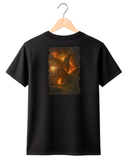
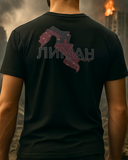
The Raccoon Merch Tryzub collection features a range of original designs for T-shirts and hoodies. These designs bring the national symbol into everyday clothing, from understated minimalist interpretations to more expressive graphic styles.
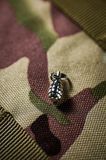
A silver Tryzub token holds a special place in the collection. Unlike clothing, whose context changes from day to day, a metal token can become a personal keepsake, a gift or a symbolic object to be treasured for years.
15. A Symbol That Connects Generations
The history of the Tryzub is a story of changing meanings and contexts. In the princely era, it was a sign of dynasty and authority. In 1918, it became the state coat of arms of the Ukrainian People's Republic. During the 20th century, it became a symbol of the struggle for independence, and after the restoration of Ukrainian statehood it once again took its place in official national symbolism.
Its original meaning remains a subject of scholarly discussion, but its historical journey can be traced through coins, seals, documents and archaeological artefacts. This continuity - from the princely emblems of Kyivan Rus to the modern State Emblem - has made the Tryzub one of the most recognisable symbols of Ukrainian history and culture.
This article is based on historical and museum sources. Each illustration is accompanied by a caption identifying its source.
What Is a Military Brigade? Structure, Size, Differences from a Regiment, and History
From Red-Hot Iron to the CAT Tourniquet: The Evolution of Hemorrhage Control
The Raccoon Merch Tactical Medicine Collection: Gifts for Those Who Save Lives
Toyota at War: The History of the Hilux and Land Cruiser in Armed Conflicts
Structure of Ukraine’s Armed Forces and Defence Forces: From Squad to Corps
Personal Body Armor: History, Evolution and the Path from Chainmail to Modern Plate Carriers
The History of Military Radio Communication: From Field Telephones to Modern Radios
What Is MOLLE and How Did This System Change Military Equipment?
The History of the Hand Grenade: From Clay Pots to 3D-Printed Drone Drops
What to Give a Commander or Officer - Gift Ideas for a Military Service Member
Military Camouflage: History, Types, and Ukrainian Pixel Camouflage
The History of Military Dog Tags: From Identification to a Symbol of Military Service
What to Gift a Soldier: 15 Meaningful Gift Ideas They'll Truly Appreciate