G3, MP5, G36, HK416.
These names have long become familiar far beyond the firearms industry. They can be found in the history of NATO armies, special forces, police units and, of course, in hundreds of films and video games.
Behind all of them stands one company - Heckler & Koch.
The German manufacturer from Oberndorf, which emerged in post-war Germany, survived the Cold War, created some of the most famous firearms of the 20th century and continues to supply weapons to military and law enforcement organizations in NATO and European countries today.
But the most interesting part of H&K's history is not simply the number of legendary models it has produced. It is the story of how the company continuously moved from one era to the next.

How Heckler & Koch Was Founded
Heckler & Koch was founded in 1949 in Oberndorf am Neckar, Germany.
The company's founders were Edmund Heckler, Theodor Koch and Alex Seidel - engineers with experience in German industry and firearms manufacturing.
The timing was difficult for a new firearms company. Germany had just gone through World War II, its traditional arms industry had been severely disrupted, and the production of weapons for German military forces was subject to strict restrictions.
As a result, Heckler & Koch was not initially a purely firearms-focused company.
But the situation in Europe was changing rapidly.
The Federal Republic of Germany established the Bundeswehr, and the new armed forces needed modern small arms.
That created an opportunity for the young company.
G3: H&K's First Great Breakthrough
The first major success of Heckler & Koch was the G3.
Its history actually began before H&K itself was founded. After World War II, German engineers working in Spain developed the CETME rifle. Heckler & Koch later adapted this design to meet the requirements of the German armed forces.
In 1959, the G3 was adopted by the Bundeswehr.
The rifle used the 7.62×51 NATO cartridge and became one of the best-known battle rifles of the Cold War era.
Its success quickly became international. G3 rifles were manufactured under license in several countries, and the platform developed into a large family of variants.
For H&K, this was the moment when the company moved beyond the German market.
The G3 became not simply a Bundeswehr rifle, but one of the defining products of the German firearms industry during the second half of the 20th century.
MP5: The Firearm Even Non-Enthusiasts Recognize
If the G3 became a symbol of the military side of Heckler & Koch, the MP5 made the company recognizable around the world.
The MP5 appeared in the 1960s as a compact weapon chambered for the 9×19 mm cartridge. Its primary users included police and special forces units that needed a compact firearm.
The MP5 gradually achieved enormous international popularity.
It was adopted by special units in many countries, including the British SAS. Its association with such units helped turn the MP5 into a symbol of counter-terrorism and special operations.
Then something happened that very few firearms achieve.
The MP5 became part of popular culture.
For decades it appeared in films, television series and video games. As a result, even people who have never been interested in firearms often recognize the distinctive silhouette of an MP5.
And despite its age, the platform remains part of Heckler & Koch's product range. The official MP5 page demonstrates just how long this platform has remained relevant.
More Than the G3 and MP5
Following the success of the G3, Heckler & Koch continued developing its concept.
The company produced the HK33, HK53, HK21 and other systems.
It also expanded into pistols, machine guns and other types of small arms.
This is an important part of understanding H&K.
The company did not build its history around a single "brilliant" model. Instead, it developed entire families of firearms designed for different roles.
But the next major change came after the end of the Cold War.
G36: A New Generation for the Bundeswehr
By the 1990s, the G3 was becoming outdated for the new requirements of modern military forces.
The nature of military operations had changed, polymers were becoming increasingly common, reducing equipment weight was becoming more important, and NATO countries were increasingly adopting the 5.56×45 NATO cartridge.
Germany needed a new standard rifle.
That rifle was the G36.
The G36 began replacing the G3 in Bundeswehr service in 1995.
It was considerably lighter than its predecessor, made extensive use of polymer components, featured a folding stock and incorporated a modern modular design.
Its distinctive appearance quickly made the G36 one of the most recognizable rifles associated with the German military.
The official G36 description from Heckler & Koch still highlights its lightweight and modular characteristics.
But the story of the G36 had a difficult chapter ahead.
![Гвинтівка Heckler & Koch G36 C IDZ - dark earth [Umarex] (для страйкболу): продажа, цена в Украине. пневматичні пістолети і гвинтівки от "AirSoft GUN" - 2003405732](https://images.prom.ua/1747384746_w1280_h640_1747384746.jpg)
The G36 Controversy
During the 2010s, Germany saw a major debate over the accuracy of the G36 during prolonged heating of the barrel.
Following a series of tests, the issue developed into a major political and media controversy. The German Ministry of Defence eventually decided that a successor to the G36 should be found.
It was an uncomfortable chapter for Heckler & Koch, but also an instructive one.
Even a rifle that had served for decades could eventually fail to meet changing operational requirements.
And once again, H&K had the opportunity to respond.
This time, with the HK416.
HK416: A New Chapter for Heckler & Koch
The HK416 became one of Heckler & Koch's most important modern designs.
In terms of ergonomics and overall layout, it is closely related to the AR-15/M16 family, while incorporating a different operating system and a number of H&K's own design solutions.
The company developed an entire HK416 family with different barrel lengths and configurations. Heckler & Koch describes the platform as suitable for infantry, military special forces and law enforcement applications. The official HK416 page provides an overview of the current family.
One of the most important international successes came from France.
France selected the HK416F to replace the FAMAS. The program called for more than 100,000 rifles for the French armed forces.
The French Directorate General of Armaments confirmed the selection of the HK416F as the FAMAS replacement and the scale of the procurement program.
This was a major moment.
Heckler & Koch had once again become the supplier of a standard service rifle for a major European military.
HK417: A Larger-Caliber Brother
The HK417 followed the concept of the HK416.
The main difference is its use of the 7.62×51 NATO cartridge instead of 5.56×45 NATO.
This created a platform for roles where greater range and the characteristics of a larger cartridge are important.
The two systems form a clear family:
HK416 - 5.56×45 NATO.
HK417 - 7.62×51 NATO.
Once again, H&K was not simply developing separate firearms for separate roles. It was building related platforms around a common design philosophy.
The official HK417 page provides information about the current family.
Heckler & Koch and NATO Militaries
Looking at the history of Heckler & Koch as a whole, it becomes clear how closely the company has been connected with NATO militaries.
The G3 became one of the most widely distributed battle rifles of the Cold War.
The MP5 achieved enormous popularity among police and special forces.
The G36 served as the Bundeswehr's standard rifle for several decades.
The HK416 was selected by France, Norway, Luxembourg and other countries.
And the story did not end there.
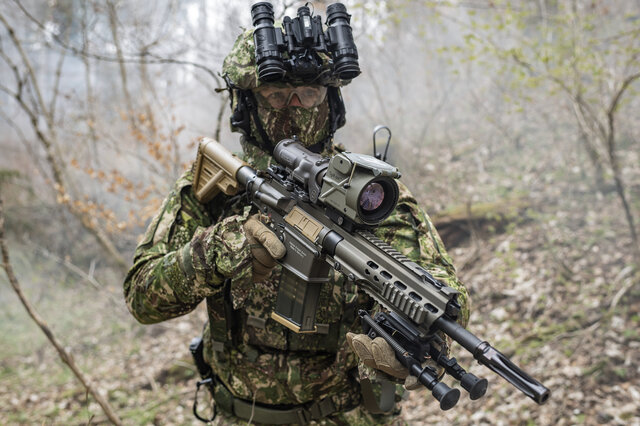
In 2025, the Bundeswehr began receiving the new G95A1 and G95KA1 standard rifles based on the HK416 A8.
In December 2025, Heckler & Koch delivered the first 300 G95KA1 rifles, while the framework agreement was expanded to 250,000 systems. The official H&K announcement confirms the first deliveries.
This means Heckler & Koch has effectively returned to the role of standard rifle manufacturer for the German military for a third generation:
G3 → G36 → G95.
Heckler & Koch in the War in Ukraine
After the beginning of Russia's full-scale invasion, various Heckler & Koch models began appearing in Ukraine.
The most prominent of them is the HK416.
The rifle has been photographed and documented in use by Ukrainian Special Operations Forces, intelligence units, the 92nd Mechanized Brigade, the 3rd Assault Brigade and members of the International Legion. Research by Armourer's Bench has documented several HK416 variants used by Ukrainian personnel since 2022-2023. The detailed research on HK416s in Ukraine provides examples of their use.
What makes this particularly interesting is not simply the presence of HK416 in Ukraine, but the feedback from people who have actually used the rifle.
In one documented case, a member of the 3rd Assault Brigade who used an HK416 described it as the "best assault rifle". Other users highlighted reliability, fewer stoppages and ease of maintenance. At the same time, the rifle's weight was mentioned as one of its disadvantages.
These are, of course, personal assessments from individual soldiers rather than a universal verdict on the platform.
But that is precisely what makes such feedback interesting. These opinions come from people who used the rifle in real combat conditions rather than during a demonstration or range test.
HK416 is not the only H&K model found in Ukraine.
Publicly available material from 2024 also documented the use of G36 and HK433 by Ukrainian special forces. Armourer's Bench documented their appearance in Ukraine and noted that these weapons were seen in relatively small numbers.
This means that several generations of Heckler & Koch firearms can now be found in the Ukrainian military environment - from the G36 to modern HK416 and HK433 systems.
HK433: Combining Different Generations
The HK433 is particularly interesting when viewed as part of H&K's evolution.
The company essentially attempted to combine experience from two of its major modern platforms - the G36 and HK416.
One notable feature concerns the controls. The HK433 can be configured with different lower receiver arrangements intended for users accustomed to different operating systems.
This means that personnel familiar with the HK416/AR-15 family or those with experience using the G36 can retain a more familiar control layout when moving to the new platform.
It is a good example of where modern H&K design is heading: not simply creating new firearms, but taking into account the experience users already have with previous generations.
The official HK433 page describes it as a modular platform combining experience from the G36 and HK416.
The Most Famous Heckler & Koch Models
Over more than 75 years, Heckler & Koch has produced a huge variety of firearms.
But if we highlight the models that had the greatest influence on the company's history, the list would look something like this:
G3 - one of the defining battle rifles of the Cold War and H&K's first major international legend.
MP5 - a legendary platform for police and special forces that became part of popular culture.
G36 - the Bundeswehr's standard rifle from the 1990s onward.
HK416 - a modern military platform that received major international contracts.
HK417 - a development of the HK416 concept chambered in 7.62×51 NATO.
HK433 - a modern modular system combining experience from the G36 and HK416.
USP - one of H&K's best-known pistols.
P30 - a modern family of H&K service pistols.
And this is far from the complete list.
What Connects the G3, MP5, G36 and HK416?
There are decades between these models.
The G3 was created for the armies of the Cold War.
The MP5 was designed for a different type of role, where compactness and controllability were especially important.
The G36 represented a new era in which military rifles had to become lighter and make greater use of modern materials.
The HK416 was born in an era of modular platforms, advanced optics and increasingly sophisticated military equipment.
And the G95 represents the next step - the development of the HK416 A8 into a new standard rifle for the Bundeswehr.
The history of H&K can therefore be seen as a series of answers to one question:
What should a military firearm look like for its era?
That is why the G3, MP5, G36 and HK416 are so different.
And that is exactly why each of them left such a significant mark on firearms history.
Good Firearms Require Good Maintenance
There is one thing that does not change regardless of the generation of firearm.
Any complex mechanical system requires proper maintenance.
For a soldier or firearm owner, maintenance is not simply a formal procedure. It is part of responsible equipment handling.
That is why Raccoon Merch offers Clarity Gun - a dedicated mat for firearm cleaning and maintenance.
It helps organize the work area, protect the surface and keep components organized during maintenance.
A small but practical piece of equipment for anyone who regularly takes care of their firearm.
See Clarity Gun at Raccoon Merch.
From G3 to G95: The Story of Heckler & Koch Continues
In 1949, Heckler & Koch was a young company founded in a very different Germany.
Ten years later, its G3 became the standard rifle of the Bundeswehr.
Then came the MP5, which became a symbol of special forces.
After that came the G36, which served as the face of the German military for decades.
Then came the HK416, which achieved international recognition and became the basis for a new generation of German standard rifles.
And at the end of 2025, the first G95KA1 rifles based on the HK416 A8 were delivered to the Bundeswehr.
More than 75 years of Heckler & Koch history is not the story of one legendary firearm.
It is a story of constant change.
G3 → MP5 → G36 → HK416 → G95.
Different eras. Different requirements. Different designs.
But one name has remained the same:
Heckler & Koch.
Clarity Gun Rubber Cleaning Mat — Instructions & Care
What to Gift a Soldier: 15 Meaningful Gift Ideas They'll Truly Appreciate
Colt: The History of the Company That Changed the World of Firearms
Glock - The History of the Company and the Pistol That Changed Modern Handguns
Beretta - The History of the World's Oldest Firearms Manufacturer
Česká zbrojovka: From a 1936 Arms Factory to the CZ BREN 2
SIG SAUER: From a Swiss Factory to One of the World's Best-Known Firearms Manufacturers
What to Give a Commander or Officer - Gift Ideas for a Military Service Member