FN Herstal is one of the best-known names in the history of European firearms. Founded at the end of the 19th century, the Belgian company began with a major government contract to manufacture Mauser rifles and later became one of the world's most recognized producers of firearms and ammunition.
Over more than 135 years, FN has created or manufactured firearms that became part of the military history of the 20th and 21st centuries: the FN High Power, FN FAL, FN MAG, FN MINIMI, P90, Five-seveN and SCAR.
But FN's history is interesting for more than just the number of legendary models it produced. It also shows how the very concept of small arms changed: from bolt-action rifles at the end of the 19th century to light machine guns, modular platforms, specialized ammunition and modern service pistols.
And today, this history has a direct connection to Ukraine. FN MINIMI and FN SCAR are used by Ukrainian military and special-operations units in the war against russia.
How Fabrique Nationale Was Founded
The history of FN began in 1889 in Herstal, Belgium, near Liège.
The Belgian government decided to order a large batch of modern military rifles. Local manufacturers joined together to fulfill the contract, creating Fabrique Nationale d'Armes de Guerre.
The company's first major contract was the production of 150,000 Mauser Model 1889 rifles for the Belgian Army. The first rifles were assembled by the end of 1891, and the first was officially delivered to the Belgian government in early 1892.
This meant that FN was designed from the beginning not as a small gunsmithing workshop, but as a major industrial company capable of large-scale production.
The official history of FN shows how the company gradually moved from its first Mauser contract to its own designs and international production.
During the 1890s, FN also began diversifying its business. Among other things, the company manufactured bicycles. Its work in the bicycle industry unexpectedly became important, because it helped FN establish contact with John Moses Browning.

FN and John Browning
In 1897, FN representative Hart O. Berg met John Moses Browning in the United States.
Browning was already a well-known designer and was working on self-loading firearms. FN, meanwhile, had the industrial capabilities needed for large-scale manufacturing.
On July 17, 1897, FN and Browning entered into a partnership that would last for almost three decades.
One of the first major results was a series of Browning pistols, beginning with the Model 1899 and Model 1900. FN produced more than 700,000 Model 1900 pistols.
In 1903, the company began manufacturing the Browning Auto-5, one of the most famous semi-automatic shotguns designed by Browning.
Browning regularly visited Herstal and worked directly with FN's engineers. This partnership gave the company not only successful firearms designs, but also helped shape FN's own engineering culture.
FN High Power - The Pistol That Became a Classic
One of the most famous products of the Belgian design tradition was the FN Browning Hi-Power, also known as the FN High Power or GP35.
John Browning worked on the design until his death in 1926. After his death, development was completed by FN's chief designer, Dieudonné Saive.
FN completed the design and began production in 1934.
One of the pistol's most important features was its high magazine capacity for the time - 13 rounds. This characteristic was reflected in the name "High Power." Over the following decades, the pistol became widely adopted by military and law-enforcement organizations in different countries.
The original High Power remained in production for roughly 80 years and became one of the most recognizable Belgian pistols of the 20th century.
Interestingly, its story did not end with the 20th century. In 2022, FN introduced a modern version of the High Power with an updated design, ergonomics and magazine capacity.
The High Power therefore became something of a bridge between the classic firearms of the first half of the 20th century and the modern generation of FN pistols.

FN During World War II
In 1940, Belgium was occupied by Germany.
The FN factory in Herstal came under occupation control, and its production facilities were used for the needs of German military industry.
At the same time, the history of FN during this period contains an important detail. Before the occupation, drawings related to the future High Power had been taken out of the factory. Some of the work connected with its production continued in Canada in cooperation with John Inglis and Company. At the Herstal plant itself, various forms of production sabotage also took place.
After the war ended, FN returned to normal production.
And the world firearms industry was entering an entirely new era.
FN FAL - The "Right Arm of the Free World"
After World War II, armies needed a new generation of automatic infantry weapons.
In 1947, FN chief designer Dieudonné Saive created the first prototype of the FN FAL - Fusil Automatique Léger, or "Light Automatic Rifle."
The original concept gradually evolved in response to changing military requirements. Eventually, the FAL was adapted to the 7.62×51 NATO cartridge.
Canada became the first country to adopt the FAL in 1954. The rifle was later adopted or produced in around 100 countries.
This made the FAL one of the best-known battle rifles of the Cold War era.
In the English-speaking world, it became famous under the nickname "The Right Arm of the Free World."
For FN, it was a major milestone. The Belgian company was no longer simply supplying firearms to the Belgian military. Its designs were becoming weapons used by entire generations of armed forces around the world.
FN MAG - The Machine Gun That Became a Global Classic
If the FAL became a symbol of FN in the world of battle rifles, the FN MAG became one of the company's defining products in the machine-gun category.
The MAG was developed after World War II by designer Ernest Vervier. It is a 7.62 mm general-purpose machine gun designed as a versatile system.
It could be used as an infantry machine gun on a bipod or mounted on armored vehicles, ships and other platforms.
Sweden became the first country to adopt the FN MAG in 1958. Britain uses the system under the L7 designation, while the American version is known as the M240.
Today, the global reach of the MAG remains impressive. According to current FN Herstal information, the platform is in service in 90 countries.
FN's updated information on the FN MAG shows that the story of this design is far from over: in 2026, FN introduced a new MAG Tactical variant with a Long Rail system and new capabilities for modern optical equipment.
More than six decades after the original MAG appeared, the company is still adapting the design to modern requirements.

FN MINIMI - A New Generation of Light Machine Guns
During the 1970s, FN began working on a new concept for a lightweight machine gun.
The result was the FN MINIMI, initially developed for the 5.56×45 NATO cartridge.
In 1988, the U.S. Army adopted the system as the M249 Squad Automatic Weapon, and production of the M249 in the United States began in 1991.
MINIMI was designed for a different role from the heavier FN MAG. Its main idea was to provide high firepower at squad level while offering lower weight and greater mobility.
The system spread internationally. According to FN Herstal, 5.56 mm Mk1 and Mk2 versions of the MINIMI were adopted in 70 countries as standard weapons for regular and special forces. The modern MINIMI Mk3 introduced updated ergonomics and a number of design improvements.
In the United States, the system is primarily known as the M249, while many other countries use the FN MINIMI designation. The same design family can therefore have different names depending on the military using it.
P90 and the Development of the 5.7×28 mm Cartridge
At the end of the 1980s, FN went a step further.
Instead of simply designing a new firearm around an existing cartridge, the company developed a new cartridge and a new weapon together.
This led to the 5.7×28 mm cartridge and the compact FN P90.
The idea was to create a system for military and law-enforcement users that would respond to new requirements of the modern battlefield.
Production of the P90 in Belgium began in 1990. FN later developed the Five-seveN pistol, which uses the same cartridge. In 2021, the 5.7×28 mm cartridge became a NATO-standardized caliber under STANAG 4509.
This is one of the most interesting examples of FN's approach to firearms development: the company created not simply a single model, but an entire "firearm + ammunition" system.
Today, FN P90 is used by military and law-enforcement organizations in different parts of the world, while Five-seveN continues to evolve in the form of the modern Mk3 MRD version.
FN SCAR - The Era of Modular Weapons
At the beginning of the 21st century, military requirements changed again.
Special operations forces needed a weapon that could be adapted to different missions, configurations and calibers.
The result was the FN SCAR platform.
Development began after USSOCOM launched a competition for a new weapon system for U.S. special operations forces. In 2004, FN SCAR was selected as the winner.
Today, the SCAR family includes variants in 5.56×45 and 7.62×51 NATO, compact configurations and specialized versions.
FN Herstal currently states that the SCAR family is in service with more than 30 armed forces and law-enforcement organizations around the world.
For FN, this became another major step forward. If the FAL represented a versatile battle rifle for its era, SCAR was created from the beginning as a modular platform for a new generation of users.

Modern FN Pistols
The history of FN pistols does not end with the legendary High Power.
Today, the company has several modern directions.
The FN 509 is a modern striker-fired 9×19 mm pistol designed for security forces. FN lists a 17-round magazine, ambidextrous controls and versions with or without a manual safety.
The FN Five-seveN Mk3 MRD continues the concept of a pistol chambered in 5.7×28 mm. The modern version features updated ergonomics and an interface for mounting miniature red-dot sights.
And the FN HiPer represents a completely new generation of Belgian service pistols. Introduced as a 9×19 mm design, it uses a modular chassis-based architecture, ambidextrous controls and FN's own patented solutions. The company positions the HiPer for military and law-enforcement use.
The development of FN pistols can therefore be roughly traced through several generations:
High Power → Five-seveN → FN 509 → FN HiPer.
From the classic design of the 1930s to modern pistols with modular architecture and optics-ready configurations.

FN and the Armed Forces of the World
One of the reasons behind FN's legendary status is the enormous geographic reach of its designs.
The same firearm often has different designations depending on the country using it.
The FN MAG is known as the M240 in the United States, the L7 in Britain and FN MAG in many other countries.
The FN MINIMI became the M249 in the United States, while the FN FAL was produced and used in different versions around the world.
Today, the FN MAG is in service in 90 countries, the 5.56 mm MINIMI in 70 countries, and the SCAR family in more than 30 armed forces and law-enforcement organizations.
This means FN firearms are part of the military history of a huge number of countries - from North America and Europe to other regions of the world.
FN Herstal and Ukraine
For Ukraine, the history of FN has particular relevance today.
In August 2024, Ukraine's National Guard reported that the "Come Back Alive" foundation had supplied the "Azov" and "Khartiia" brigades with 51 FN MINIMI machine guns in 7.62 NATO. At that time, the foundation had supplied a total of 150 FN MINIMI machine guns to Ukraine's Defense Forces.
Separately, Ukraine's Air Assault Forces reported the transfer of 40 FN MINIMI 7.62 mm machine guns to personnel of the 82nd Separate Air Assault Brigade.
This means the FN MINIMI is not simply a firearm seen occasionally in photographs of Ukrainian troops. It has been procured and supplied to specific units of Ukraine's Defense Forces.
FN SCAR is also used by Ukrainian special operations units. In an interview with ArmyInform, a recruiter from a Ukrainian Main Intelligence Directorate special-operations unit stated that its personnel work with FN SCAR alongside AK and AR-platform weapons.
ArmyInform's report on FN SCAR use by a Ukrainian special-operations unit provides a concrete Ukrainian context for the modern history of FN.
The Belgian firearms manufacturer that began more than a century ago with Mauser rifles for the Belgian Army therefore has a very real place in the history of Ukraine's current defense.
FN Herstal Today
In 2024, the company's parent structure officially changed its name from Herstal Group to FN Browning Group. The new name emphasized the two historic brands at the center of the group - FN and Browning.
Today, FN Herstal focuses primarily on the Defence & Security sector.
Its current portfolio includes FN SCAR, FN MAG, FN MINIMI, P90, Five-seveN, FN 509, HiPer and other systems. The company also continues to develop new platforms and modernize established designs.
This is one of FN's defining characteristics: the company did not simply create a handful of legendary models. It has spent decades adapting those designs to changing requirements.
Maintaining FN Firearms
No matter how modern or reliable a firearm is, regular maintenance remains an important part of its use.
During cleaning, it is useful to have a dedicated workspace where small parts do not get lost and lubricant or residue does not spread across the table.
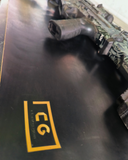
For this purpose, Clarity Gun firearm cleaning mats are available from Raccoon Merch.
A dedicated cleaning mat helps organize the workspace when maintaining rifles, carbines, machine guns and pistols while protecting the surface from lubricant and dirt.
FN Herstal: From Mauser to Modern Warfare
The history of FN Herstal began in 1889 with a major Belgian contract to manufacture Mauser rifles.
Then came John Browning and his designs, the legendary High Power, FN FAL, FN MAG, MINIMI, P90, Five-seveN and SCAR.
Some models became symbols of the Cold War. Others helped define entire categories of modern small arms.
And the most interesting part is that many of them never really became history in the past tense.
FN MAG is still used in 90 countries, the 5.56 mm MINIMI in 70 countries, and SCAR in more than 30 armed forces and law-enforcement organizations around the world.
In Ukraine, FN MINIMI is already directly used by units of the Defense Forces, while FN SCAR has a documented role among Ukrainian special-operations personnel.
That is perhaps the clearest way to understand the scale of FN Herstal's history.
A Belgian factory that began in the 19th century by manufacturing Mauser rifles now produces systems used around the world and continues to play a role in modern armed conflicts.
From the classic rifle to the modular SCAR, from the High Power to the HiPer, from the MAG to the MINIMI, FN has evolved alongside changing technology and military requirements.
But one characteristic has remained unchanged: FN designs firearms with a long service life in mind.
Remington: The History of a Legendary American Firearms Maker
Winchester: The History of a Legendary American Firearm
Mauser: The History of a Rifle That Became a Global Standard
The History of Smith & Wesson: From the First Cartridge Revolver to Magnum
Heckler & Koch: The History of German Firearms That Became Legendary
SIG SAUER: From a Swiss Factory to One of the World's Best-Known Firearms Manufacturers
Česká zbrojovka: From a 1936 Arms Factory to the CZ BREN 2
Military Intelligence of Ukraine - History, Development and Modern Role
Beretta - The History of the World's Oldest Firearms Manufacturer
Glock - The History of the Company and the Pistol That Changed Modern Handguns
What to Give a Commander or Officer - Gift Ideas for a Military Service Member
Clarity Gun Rubber Cleaning Mat — Instructions & Care
What to Gift a Soldier: 15 Meaningful Gift Ideas They'll Truly Appreciate