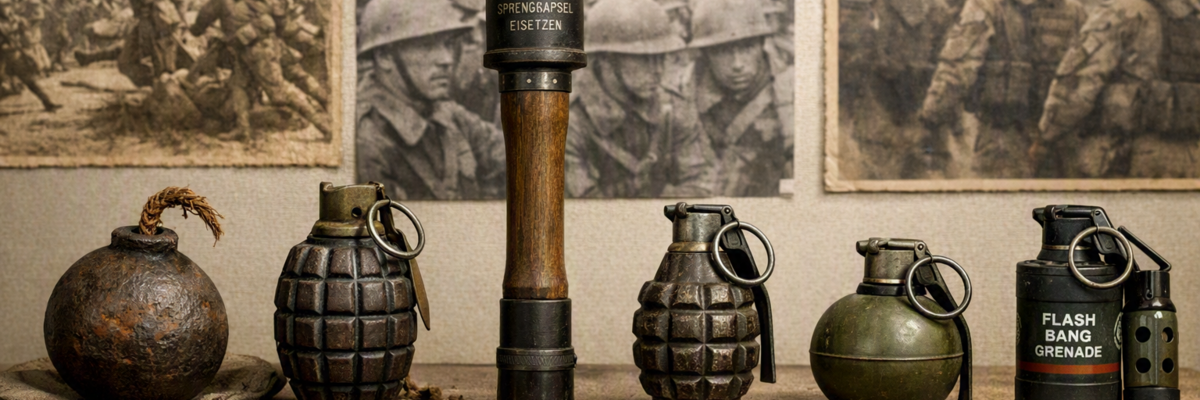
The hand grenade concept has remained virtually unchanged for centuries: a compact munition thrown by an infantryman to neutralize targets via fragmentation or blast overpressure. The grenade has always been the ultimate equalizer in close-quarters combat, clearing bunkers, trenches, and rooms without direct line-of-sight exposure.
However, the path from fragile vessels filled with black powder to modern precision aerial drops and thermobaric charges represents a long evolution of military engineering.
Early Origins: From China to Byzantium (10th–15th Century)
The earliest explosive close-combat weapons emerged in the East:
-
Ancient China (9th–11th Century): Following the invention of gunpowder, Chinese armorers filled ceramic, paper, and bamboo containers with explosive mixtures. As documented in the 1044 military treatise Wujing Zongyao (Military Compendium), these were known as Fei Huo Pao (flying fire bombs) and used to disrupt enemy cavalry and burn wooden fortifications.
-
"Greek Fire" in Byzantium (10th–12th Century): Byzantine forces threw clay and glass jars filled with petroleum-based incendiary fluids ignited by a burning wick.
-
The Metal Casing (15th Century): Advancements in metallurgy across Europe led to cast iron and bronze gunpowder spheres. The term originates from the Spanish granada (pomegranate), as shattering metal fragments resembled the fruit's scattered seeds.
The Era of Grenadiers (17th–18th Century)
By the 17th century, grenades became standardized equipment, leading to the formation of specialized elite assault units: grenadiers.
Early grenades were heavy cast-iron spheres weighing 1 to 3 kg equipped with slow-burning match fuses. Deploying them demanded physical strength, tall stature, and extreme bravery to advance within throwing distance (20–30 meters) under enemy fire. Detailed tactical history of these assault troops is preserved in Encyclopædia Britannica: Grenadier. Grenadiers quickly became the pride of the infantry, and the burning grenade emblem remains an iconic military symbol of valor.
Offensive vs. Defensive: Tactical Classification
The trench warfare of World War I revived the necessity for hand-thrown explosives, establishing the modern division based on fragmentation casualty radius:
| Attribute | Defensive Grenades | Offensive Grenades |
| Classic Examples | F-1, Mills Bomb, MK2 | RGD-5, M67 (conceptually), RG-42 |
| Construction | Thick cast-iron or pre-fragmented steel matrix | Thin sheet metal or lightweight plastic |
| Primary Effect | Heavy high-velocity fragments | Blast overpressure + light fragmentation |
| Lethal Radius | Up to 100–200 meters (exceeds throw range) | 5–15 meters (within safe throw range) |
| Deployment | Strictly from cover (trenches, armored vehicles) | While advancing in the open |
Thermobaric and Specialized Ordnance
Beyond traditional high-explosive fragmentation designs, specialized variants evolved to handle unique combat scenarios:
1. Thermobaric Grenades (Fuel-Air Explosives)
Engineered to eliminate personnel inside bunkers, enclosed spaces, and fortified positions (e.g., Ukrainian RGT-27S). Upon initiation, the grenade disperses an aerosol fuel cloud that detonates instantly, producing extreme temperatures and a violent pressure drop (vacuum effect) that breaches unsealed enclosures.
2. Stun Grenades (Flashbangs)
Utilized by tactical teams to temporarily incapacitate targets. They produce a blinding flash of several million candela and a deafening sound blast (170–180 dB) without generating lethal shrapnel.
3. Smoke and Incendiary
Deployed for screening troop maneuvers, signaling air support, or destroying equipment via high-temperature thermite reactions.
Extending the Range: From Throws to Grenade Launchers
Human physical limits cap hand-throwing range at roughly 30–40 meters. To extend this distance, several platforms emerged:
-
Rifle Grenades (WWI–WWII): Attached directly to the muzzle of a service rifle and propelled by blank or live cartridges up to 100–150 meters.
-
Under-Barrel Grenade Launchers (GP-25, M203): Compact systems mounted beneath an assault rifle barrel, firing specialized low-velocity rounds (e.g., VOG-25, 40mm NATO) up to 400 meters.
-
Automatic Grenade Launchers (AGS-17, MK-19): Heavy crew-served weapons capable of rapid sustained fire at ranges extending up to 1,500–2,200 meters.
Modern Era: Hand Grenades + Unmanned Aerial Vehicles
In modern warfare, traditional hand grenades and launcher rounds have been repurposed as precision air-dropped munitions.
Defensive (F-1, M67), offensive (RGD-5), and launcher rounds (VOG-17/25) are routinely fitted with 3D-printed tail fins and impact fuses. Deployed from commercial quadcopters and FPV drones, these modified hand grenades strike open tank hatches and trench dugouts with surgical accuracy from high altitudes.
Heritage and Tactical Jewelry
The iconic grenade silhouette transcends its functional battlefield role, standing as a symbol of tactical readiness, resilience, and explosive power.
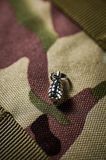
At Raccoon Merch, we translated this iconic aesthetic into a signature piece of tactical jewelry. We crafted a detailed silver grenade pendant — a bold symbol of resilience, explosive character, and identity for those who value military history.
The Evolution of FPV on the Frontline: How a Civilian Hobby Reshaped Modern Warfare
What to Give an FPV Pilot - Gift Ideas for an FPV Drone Pilot
What to Give a Commander or Officer - Gift Ideas for a Military Service Member
Military Camouflage: History, Types, and Ukrainian Pixel Camouflage
Military Patches: How a Small Patch Became a Symbol of Military Culture
What to Gift a Soldier: 15 Meaningful Gift Ideas They'll Truly Appreciate