Just a few years ago, a drone on the battlefield was primarily a pair of eyes. It rose above positions, searched for targets, adjusted artillery fire, and sometimes dropped a small munition. Today, that is no longer enough to describe the role of unmanned systems in Ukraine's war against Russia.
FPV drones operate directly on the battlefield. Reconnaissance drones build a picture of the situation. Ground robotic systems perform combat and logistical tasks. Maritime drones have changed the nature of warfare at sea. Long-range unmanned systems can reach Russia's military and fuel infrastructure hundreds and even thousands of kilometers from the front.
Ukraine did more than adapt drones to warfare. It created a dedicated military structure around them. The Unmanned Systems Forces of the Armed Forces of Ukraine are the world's first dedicated branch of forces built around the systematic use of unmanned aerial vehicles, ground robotic systems, and maritime surface and underwater drones.

It Started Very Differently
The story of modern Ukrainian drone warfare did not begin with large production lines, dedicated command structures, or state programs. It began with commercial quadcopters, volunteer support, and soldiers trying to use whatever technology was available where standard means were not enough.
The Mavic was initially used primarily for reconnaissance. Then drop systems appeared. Soldiers learned to adjust fire, locate targets, and operate drones under real battlefield conditions. What first looked like improvised adaptation gradually became a distinct area of military operations.
Then came FPV.
On June 10, 2022, according to Ukrainian official military sources, the first successful combat use of an FPV drone took place. The historic flight was carried out by soldiers of the SIGNUM battalion - "Tourist," "Schweiger," and "Baghdad." Footage from the operation became known by the phrase "Fourth House. Blue Doors."
It was a small episode in the scale of a major war. Technologically, however, it became a pivotal moment. FPV showed that a small and relatively simple aircraft could become not only an operator's eyes, but a direct means of striking a target.
Про цей епізод та історію першого бойового застосування можна прочитати в матеріалі АрміяInform.
First, the drone was an eye. Then it gained the ability to drop munitions. With FPV, the drone itself became a means of striking a target.
From a Mavic Drop to a Dedicated Branch of Forces
The evolution of Ukraine's unmanned systems can be described in several stages: reconnaissance, drops, FPV, strike UAVs, ground robotic systems, maritime systems, electronic warfare, analytics, and digital command and control.
Importantly, the focus gradually stopped being on any particular type of drone. The very logic of using the technology was changing. The unmanned system became part of an integrated system in which reconnaissance, data transmission, analysis, strike, and assessment of results are connected.
That is why the creation of the Unmanned Systems Forces was not simply a decision to "create more drone operators." It was about forming a dedicated branch of forces capable of systematically using unmanned and robotic systems in the air, on land, and at sea.
On June 25, 2024, Presidential Decree No. 382/2024 formally established the Unmanned Systems Forces as a separate branch within the Armed Forces of Ukraine. The accompanying National Security and Defense Council decision specifically stated that the goal was to expand the Armed Forces' capabilities in using unmanned and robotic air, maritime, and ground systems.
Official text of Presidential Decree No. 382/2024 фіксує юридичний момент, коли ця нова модель отримала статус окремого роду сил.
Why This Is the World's First Dedicated Branch of Forces
Ukraine did not invent unmanned systems. They had been used by militaries around the world long before the full-scale war. The novelty of the Unmanned Systems Forces lies not in the existence of drones themselves, but in how they are organized and integrated into a military structure.
The Unmanned Systems Forces bring together aerial unmanned systems, ground robotic systems, maritime surface and underwater drones, reconnaissance and strike capabilities, and operations at different levels - from the battlefield to strategic depth.
In other words, the unmanned system is no longer simply an additional tool for infantry, artillery, or reconnaissance. It becomes the foundation of a distinct military capability.
Саме так Сили безпілотних систем сьогодні визначає Міністерство оборони України - as the world's first dedicated branch of forces to systematically use aerial, ground, and maritime unmanned systems.

"Magyar": From the "Birds" to Commanding the Unmanned Systems Forces
One of the best-known stories of Ukrainian drone warfare is connected with Robert Brovdi, known by the call sign "Magyar." His path illustrates how individual battlefield experiments gradually developed into a systematic military capability.
In 2022, the "Magyar's Birds" unit emerged, actively developing the use of unmanned systems. What began as the work of a small team later grew into a major unit and eventually became part of a broader system.
In June 2025, Robert Brovdi became Commander of the Unmanned Systems Forces. In the autumn of the same year, during a report to the President, he said that the USF accounted for about 2% of the total strength of the Armed Forces of Ukraine but were responsible for 35% of the destruction and strikes against enemy personnel and other targets.
The story is also revealing because it mirrors the development of the Unmanned Systems Forces themselves: from a small team searching for effective solutions to a system capable of scaling the best practices across the military.
"Drone Line": When Individual Units Become a System
The next step was to scale the experience of the most effective drone units. One such project is "Drone Line," created to spread a new model of technology-driven warfare.
The idea is to create a persistent strike zone in which the enemy cannot move freely without risking losses. "Drone Line" envisions systematic use of unmanned systems at a depth of 10-15 km, and more than 1,000 crews are already involved in the project.
Units working within this system include K-2, Achilles, RAROG, Magyar's Birds, NEMESIS, Steppe Predators, Hawks, Raid, and others.
According to the Ministry of Defence, units participating in or supported by "Drone Line" strike approximately one in every four targets on the battlefield.

From the Front Line to Operational Depth: Middle Strike
Alongside the development of FPV, another process began - increasing range and changing the nature of targets.
While FPV became one of the main tools directly on the battlefield, middle strike extends the impact of unmanned systems deeper into enemy territory. It targets logistics, warehouses, equipment, command posts, and supply routes at operational depth.
This is a fundamentally different logic. The task is no longer simply to destroy equipment once it reaches positions near the front. It is also about disrupting the system that delivers, supplies, and supports that equipment.
In May 2026, the Ministry of Defence launched the "Logistics Lockdown" program and allocated an additional UAH 5 billion for the procurement of modern middle-strike systems. The goal is to scale capabilities for systematic strikes against Russian logistics, warehouses, equipment, command posts, and supply routes.
If FPV changes the battlefield, middle strike changes the logistics of war.
Deep Strike: When the Rear Is No Longer the Rear
The next level is deep strike. Here, distances are measured in hundreds and thousands of kilometers.
Ukraine has gradually turned long-range strikes from isolated high-profile operations into a systematic capability. In 2022, Ukrainian strike systems reached a military target roughly 630-650 km away. By 2024, the range had expanded to 1,200-1,500 km. In 2026, the Ministry of Defence reported strikes against targets at distances of around 1,750 km.
Russia's oil infrastructure has become a particularly revealing target set. Refineries are not merely industrial facilities. Fuel is part of military logistics, while refining capacity is tied to the broader ability of the economy to sustain the war.
In February 2026, Ukraine's Defence Forces struck the Ukhta oil refinery in the Komi Republic, approximately 1,750 km from Ukraine's state border. In 2026, refineries in Ufa and other oil infrastructure facilities were also struck.

As a result, the very concept of a rear area is changing. Distance no longer guarantees safety from attack. Military logistics, industry, and fuel infrastructure become part of a broader space in which the enemy must account for the possibility of strikes.
The First Year: From Experiment to System
Two moments are important to distinguish here. The Unmanned Systems Forces were legally established as a separate branch in June 2024. In June 2025, the USF grouping was formed, making it possible to assess its development over its first full year.
According to the Ministry of Defence, during that year alone the USF grouping struck Russian targets of various levels valued at nearly $40 billion.
The figure matters not only by itself. It shows how far Ukrainian unmanned warfare has moved from the original model in which a small quadcopter assisted a reconnaissance team or artillery unit.
Today, the system covers the tactical level, operational depth, and long-range strikes against strategic targets. Aerial, ground, and maritime systems operate within one branch of forces, while the experience of individual units is scaled into a much larger system.
From the "Blue Doors" to Oil Refineries
Viewed across just a few years, the contrast is striking.
First - a commercial Mavic and improvised drops.
Then - the first FPV systems and the story of the "Fourth House. Blue Doors."
After that - mass FPV use, the development of reconnaissance, strike drones, robotic systems, and counter-drone capabilities.
Then came "Drone Line," turning successful individual units into a scalable system.
Then middle strike, taking the fight into logistical depth.
And finally - deep strike, when Ukrainian unmanned systems reach strategic infrastructure thousands of kilometers from the front.
This is no longer simply the story of one weapons system evolving. It is the story of technology gradually changing military organization, tactics, and the very concept of the depth of war.
FPV as a Symbol of a New Ukrainian War
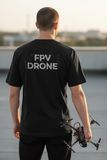
FPV has become one of the most recognizable symbols of this transformation. But behind a small drone stands much more than an operator with a controller.
It includes component manufacturers, engineers, designers, programmers, repair technicians, analysts, reconnaissance specialists, commanders, and crews working with these technologies every day at the front. This ecosystem is what allowed an isolated experiment to become a full-fledged military capability.
Raccoon Merch FPV Collection
At Raccoon Merch, we dedicated a separate FPV collection to this story. It includes a token, patches, T-shirts, and hoodies - products united by the theme of Ukrainian drone warfare and the people who change its rules every day.
Explore the Raccoon Merch FPV Collection
A War That Is Changing Right Now
The Unmanned Systems Forces did not emerge because Ukraine wanted to create a "technology army" for technology's sake. They emerged as a response to the reality of war.
First, soldiers learned to use what was available. Then they began creating their own solutions. Next, they scaled the best practices. Eventually, they built a dedicated branch of forces.
That is the core of what makes the USF new.
Drones stopped being simply weapons. They became a distinct system of warfare.
And if the history of Ukraine's modern unmanned forces is ever written decades from now, it may well begin with a very simple image: a few people, a small FPV drone, and the "Blue Doors." What followed was the story of how a technology born from a battlefield experiment became the world's first dedicated branch of forces.
Ukrainian Marines: History, Combat Path and the Modern Marine Corps
Ukrainian Special Operations Forces (SSO): History, Structure, Training, and Combat Missions
ArmaLite and the AR Family: From the AR-10 and AR-15 to the M16, M4 and Ukrainian UAR-15
Military Intelligence of Ukraine - History, Development and Modern Role
Glock - The History of the Company and the Pistol That Changed Modern Handguns
The History of RadioMaster: How RadioMaster Transmitters Became a Standard for FPV Pilots
The Evolution of FPV on the Frontline: How a Civilian Hobby Reshaped Modern Warfare
What to Give an FPV Pilot - Gift Ideas for an FPV Drone Pilot
What to Give a Military Medic: 17 Gift Ideas for Combat Medics, Paramedics and Tactical Medics
What to Gift a Soldier: 15 Meaningful Gift Ideas They'll Truly Appreciate