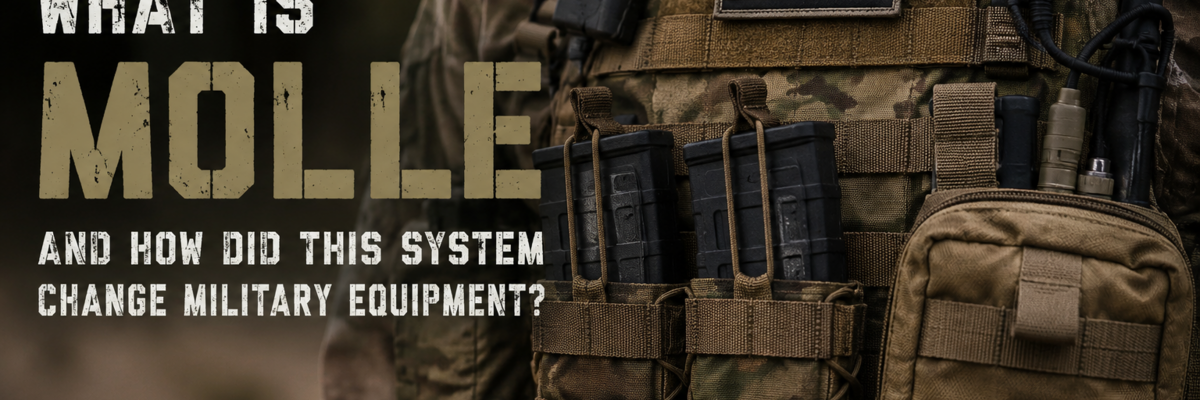
If you look at modern military equipment, one detail is almost impossible to miss: rows of horizontal webbing on body armor, backpacks, belts, and pouches.
These strips can hold magazine pouches, medical kits, radios, canteens, grenades, tools, and countless other pieces of equipment.
Today, the system is so widespread that many people see it as almost synonymous with modern tactical equipment.
It is called MOLLE.
But what does that word actually mean? Where did MOLLE come from? How is it different from PALS? And why did such a simple modular attachment concept have such a major impact on military equipment?


What Is MOLLE in Simple Terms?
MOLLE stands for Modular Lightweight Load-carrying Equipment.
Despite the complicated name, the basic idea is quite simple.
Instead of permanently attaching every pocket and pouch to a backpack, load-bearing vest, or other piece of equipment, MOLLE creates a modular platform.
That platform has rows of webbing.
Different pieces of equipment can then be attached to the webbing and rearranged according to the mission.
For example, one soldier might configure a platform with:
-
magazine pouches;
-
a medical pouch;
-
a radio pouch;
-
a canteen;
-
an administrative pouch.
Another soldier can use the same basic platform but create a completely different configuration.
That is the central idea behind MOLLE:
one system - many equipment configurations.
The U.S. Army describes MOLLE as a modular system that allows soldiers to tailor their equipment to their needs and mission requirements. (cpeground.army.mil)
MOLLE and PALS Are Not the Same Thing
The two terms are often used interchangeably, but technically they are not identical.
PALS stands for Pouch Attachment Ladder System. It refers to the webbing system used to attach pouches and other equipment.
MOLLE is the broader modular equipment system built around this attachment concept.
The U.S. Army's historical survey describes MOLLE equipment as load-bearing systems and subsystems using woven PALS webbing for modular pouch attachment. The PALS grid consists of horizontal one-inch webbing arranged at regular intervals. (history.army.mil)
So, in simplified terms:
PALS is the attachment system, while MOLLE is the broader equipment system built around modularity.
In everyday conversation, however, MOLLE is often used to describe the characteristic rows of webbing themselves.
What Came Before MOLLE?
To understand why MOLLE became important, it helps to look at what came before it.
One of the major U.S. military load-carrying systems was ALICE - All-purpose Lightweight Individual Carrying Equipment.
The ALICE system was adopted in 1973 and became an important part of American military equipment for decades. (armyupress.army.mil)
However, the system relied on traditional methods of attaching pouches, including metal clips.
These clips could come loose, and the system offered less flexibility for changing the configuration of equipment. The later PALS attachment system addressed some of these limitations by using an interlacing webbing system. (U.S. Army)
At the same time, military equipment itself was becoming more complex.
There were:
-
new communications equipment;
-
improved body armor;
-
modern medical equipment;
-
new types of ammunition;
-
additional tools;
-
electronic devices.
Soldiers were carrying more different types of equipment.
But the problem was not simply the amount of equipment.
It also needed to be organized according to the specific mission.
That is where modularity became particularly valuable.
How Was MOLLE Developed?
The development of MOLLE involved U.S. military research organizations, including the U.S. Army Soldier Systems Center in Natick, Massachusetts.
The system was designed as a new approach to load carriage rather than simply a new type of pouch.
A 1998 U.S. Army Infantry publication described MOLLE as a system intended to improve battlefield performance, increase comfort, reduce fatigue, and allow soldiers to tailor their loads to specific missions. (benning.army.mil)
The concept was important because different military roles require different equipment.
A rifleman does not need exactly the same configuration as a medic.
A grenadier does not need exactly the same configuration as a machine-gunner.
The system was therefore designed around a simple principle:
standardized components, customized configurations.


When Did the Military Start Using MOLLE?
There is an interesting detail here: different official U.S. Army sources use slightly different milestones when describing the introduction of MOLLE.
The Army's historical survey states that MOLLE was first introduced in 1997. It also notes that widespread issue did not occur until 2003. (history.army.mil)
An Army publication from 2000 stated that MOLLE equipment was scheduled to begin being issued to Army units in October 2001. (benning.army.mil)
The system's widespread use accelerated after the September 11, 2001 attacks and the subsequent wars in Afghanistan and Iraq. (U.S. Army)
This is a useful distinction when discussing military equipment:
development → testing → planned fielding → adoption → widespread issue.
Those stages do not necessarily happen in the same year.
How Does MOLLE Work?
At first glance, the principle is remarkably simple.
Horizontal webbing is attached to the main piece of equipment.
A pouch has corresponding attachment straps.
The attachment is woven through the webbing and secured in place.
The result is a modular system in which the pouch becomes firmly integrated with the platform.
The basic logic is:
remove → reposition → add → replace.


This is the key advantage.
If a soldier needs a different equipment configuration for another mission, there is no need to replace the entire system.
Individual modules can simply be moved, removed, or replaced.
What Can Be Attached to MOLLE?
Almost any piece of equipment for which a compatible attachment is available.
Common examples include:
-
magazine pouches;
-
medical pouches;
-
grenade pouches;
-
radio pouches;
-
canteens and hydration systems;
-
administrative pouches;
-
tool pouches;
-
knives and multitools;
-
flashlights;
-
additional bags.
The U.S. Army specifically describes MOLLE as supporting ammunition, first-aid, canteen, grenade, and radio pouches among other equipment. (cpeground.army.mil)
But the most important feature is not what can be attached.
It is that the soldier can decide where it should be located.
Why Was Modularity So Important?
Imagine two soldiers.
One works with medical equipment.
The other relies heavily on communications equipment.
They do not need identical loadouts.
That is why MOLLE was not designed as one universal configuration for everyone.
The U.S. Army's MOLLE system included mission-specific configurations such as the Rifleman, Pistolman, Grenadier, SAW Gunner, and Medic Sets. (peosoldier.army.mil)
The philosophy is therefore quite simple:
not one loadout for everyone, but one system for different roles.
This was a major change in the way individual military equipment could be organized.
MOLLE Changed More Than Pouches
It is easy to think of MOLLE as simply a better way of attaching pouches.
Its influence was much broader.
The modular principle changed the way equipment itself was designed.
A manufacturer could create:
-
a basic platform;
-
a separate pouch;
-
a separate medical kit;
-
a separate bag;
-
a separate organizer.
All of these components could work together.
Military equipment began to resemble a construction system.
Instead of designing one complete piece of equipment for one specific purpose, designers could create compatible components that could be combined in different ways.
That principle became one of the defining characteristics of modern tactical equipment.
MOLLE Wasn't Perfect From the Beginning
Today, MOLLE seems like an obvious and mature solution.
The first versions, however, had their problems.
The most significant issues appeared with the larger rucksacks.
Operational testing identified problems with the plastic frame, zippers, and strap length when the equipment was used with bulky body armor. Some airborne soldiers continued using older ALICE rucksacks while using other MOLLE components. (U.S. Army)
This is an important part of the history of military equipment.
A new system does not automatically become better than the old one in every detail.
It is tested, criticized, modified, and tested again.
MOLLE followed exactly this path.
The Army later developed improved versions of the system, including the MOLLE 4000 rucksack for airborne units, incorporating lessons learned from earlier equipment and feedback from soldiers. (U.S. Army)


MOLLE Went Far Beyond the Military
Today, the characteristic MOLLE webbing can be found far beyond military uniforms.
The concept has spread to:
-
tactical backpacks;
-
outdoor equipment;
-
medical bags;
-
law-enforcement equipment;
-
first-responder gear;
-
hiking and camping products;
-
automotive accessories.
The U.S. Army's DEVCOM Soldier Center notes that the technology developed for military use has also found applications among law enforcement, first responders, and outdoor users. (cpeground.army.mil)
This is a familiar path for many military technologies:
military → civilian equipment → mass market.
Advantages of MOLLE
The popularity of MOLLE is not simply a result of its military origins.
It has several practical advantages.
Modularity
The configuration can be changed without replacing the entire system.
Personalization
Equipment can be adapted to a specific person and task.
Versatility
One platform can work with many different pouches and accessories.
Scalability
A basic configuration can be expanded or modified as requirements change.
The ability to tailor equipment to a particular mission is one of the central ideas behind the MOLLE system described by the U.S. Army. (peosoldier.army.mil)
But MOLLE Has Disadvantages Too
Modularity does not automatically mean comfort.
If dozens of pouches are attached to a backpack or plate carrier without a clear purpose, the equipment can become:
-
heavier;
-
bulkier;
-
less comfortable;
-
more difficult to use.
There is also a practical problem: every additional pouch adds weight and takes up space.
That is why modern equipment design is increasingly about finding the right balance between:
modularity + weight + durability + accessibility.
More MOLLE does not necessarily mean better equipment.
The best configuration is the one that carries what is actually needed, where it can be accessed efficiently.
How Is MOLLE Still Evolving?
The modular principle has not disappeared.
But the way it is implemented continues to change.
Alongside traditional sewn webbing, modern equipment increasingly uses lighter constructions, laser-cut materials, and different ways of integrating modular attachment points into plate carriers, backpacks, and bags.
The basic idea remains the same.
But the goal is changing.
If the early MOLLE philosophy was:
"Equipment should be configurable."
Modern equipment increasingly adds:
"Equipment should be configurable without unnecessary weight."
That balance between flexibility and weight will likely remain one of the key directions in the evolution of modular load-bearing equipment.
How Did MOLLE Change Military Equipment?
The most important change did not happen at the level of the webbing.
It happened at the level of the philosophy of equipment.
The older approach could largely be summarized as:
Here is the backpack. Here are the pouches. Here are their positions - use them.
MOLLE introduced a different model:
Here is the platform - configure it for yourself and your mission.
It may sound like a small change.
In reality, it made it possible to create a huge number of different configurations from the same basic components.
That is why MOLLE became one of the most recognizable principles of modern military equipment.
It did not simply provide soldiers with a new way to attach pouches.
It changed the way modern equipment could be designed: modular, adaptable, and tailored to a specific person and a specific mission.
MOLLE in Modern Military Culture
Today, MOLLE is so common that it is easy to overlook.
Rows of webbing have become a visual characteristic of modern tactical equipment.
But behind that simple pattern is an important change.
Military equipment is no longer just a collection of things a soldier has to carry.
It has become a system that can be configured, modified, and adapted.
That is the real legacy of MOLLE.
Its importance is not in the strips of webbing themselves.
It is in the idea behind them:
equipment does not have to dictate how it is used - it can be adapted to the person, the role, and the mission.
Related Articles
-
Military Camouflage: History, Types and Ukrainian Pixel - the evolution of another important part of modern military equipment.
-
Military Patches: How a Small Piece of Fabric Became a Symbol of Military Culture - about one of the most recognizable elements of modern military equipment, often attached to MOLLE-compatible platforms.
-
What Should Be in a Military Individual First Aid Kit? - a natural continuation of the discussion about modular medical equipment.
-
The History of the Hand Grenade: From Clay Pots to 3D-Printed Drone Drops
-
What to Give a Commander or Officer - Gift Ideas for a Military Service Member
-
What to Gift a Soldier: 15 Meaningful Gift Ideas They'll Truly Appreciate