A military vehicle does not necessarily have to be armored or purpose-built for the armed forces. In many cases, the starting point is a production pickup, SUV, van or truck, fitted with equipment to meet a unit’s specific needs. One vehicle may need extra range and the ability to get out of mud; another may require protected communications and power for its electronics; a third needs space for stretchers and medical equipment.
Military fit-out is therefore more than a random collection of accessories. It is a system of decisions in which compatibility, secure mounting, maintainability and a clear understanding of each modification’s purpose all matter. Additional equipment can significantly expand a vehicle’s capabilities, but it can also add weight, complicate maintenance or introduce new risks.

1. Preparing a Vehicle for Military Use
The first level of preparation is not armor or complex electronics. It is the equipment that helps a vehicle remain operational and complete its tasks far from a regular service station. In the field, a minor breakdown or a missing tool can matter more than the vehicle’s headline specifications.

A basic kit may include a spare wheel, compressor, tire-pressure gauge, tire-repair kit, jack rated for the vehicle’s weight, wheel tools, basic hand tools, flashlights, gloves, a towing aid, a shovel and cleaning supplies. The exact kit depends on the vehicle, routes, season and availability of recovery support. Carrying two spare wheels may make sense on routes where tire damage is likely, but the extra weight and space may be a disadvantage for another vehicle.
First-aid kits and tourniquets deserve particular attention. Medical supplies must be easy to reach while being protected from dirt, moisture, heat and accidental damage. A tourniquet secured in a door pocket or dedicated holder may be easier to access than one buried under cargo. Simply putting it in the door is not enough: it must not fall out, become contaminated or interfere with the door. The crew should know where it is stored, and medical supplies should be checked regularly.
Fuel cans and fuel planning are just as important. A canister must be designed for fuel, seal properly and be securely mounted outside the cabin or in a suitable compartment. It must not swing loose, obstruct visibility, block access to the spare wheel or create a hazard for people inside the vehicle. Extra fuel increases range, but it also adds weight and fire risk.
The cabin should have designated places for tools, first-aid supplies, communications equipment, documents and personal kit. A heavy object left unsecured can become a dangerous projectile during hard braking or a collision. Nets, straps, storage boxes, organizers and proper mounting points are therefore not cosmetic extras; they are part of safe vehicle organization.
2. Lighting, Camouflage and Night Driving
Auxiliary lighting on a military vehicle can serve several purposes: illuminating the area around the vehicle, helping with repairs, lighting the cargo compartment or supporting normal driving. At the same time, excessive or poorly aimed light can reveal the vehicle’s position or dazzle the driver and other road users.

Military vehicle lighting has long included dedicated blackout modes. Blackout driving does not simply mean switching every light off. Military vehicles have used special front and rear blackout lamps that provide limited visual cues for orientation and convoy spacing without illuminating the road like ordinary headlights. The U.S. Army driver’s manual describes these lamps and notes that driving in this mode requires training. The U.S. Army driver’s manual explains the purpose of blackout lamps.
Compatibility with night-vision devices is another consideration. Infrared illumination can be visible to equipment operating in the relevant spectrum without necessarily being visible to the unaided eye. This does not mean that any infrared lamp will automatically work with any night-vision device: wavelength, output, optics and system compatibility all matter.
Camouflage is about more than applying a pattern. Glossy surfaces, chrome trim, glass, mirrors and screens can reflect light. Matte finishes and camouflage materials reduce unwanted reflections, but they do not make a vehicle invisible. Sunshades and screen hoods can help limit reflections inside the cabin while keeping navigation displays readable.

3. Small Modifications That Change a Vehicle’s Functionality
The most useful changes are not always the most dramatic. Often, modest modifications turn an ordinary cabin into a practical crew workspace. These include mounting, power supply, storage, visibility and access to essential items. They do not add armor or off-road capability, but they can make a vehicle much more useful in everyday operations.

Mounting Systems and Cabin Organization
- Radio and intercom mounts. Keep devices within reach instead of leaving them loose on seats or the center console.
- Tablet, navigation and display mounts. Secure devices without blocking the driver’s view or interfering with the controls.
- Mounting panels and rail systems. Make it possible to arrange different devices and change their positions without rebuilding the entire dashboard.
- Organizers, boxes and nets. Provide dedicated places for tools, cables, documents, first-aid supplies and personal equipment.
- Secure external mounts. Used to carry spare wheels, fuel cans, shovels, jacks, recovery lines and other equipment. Secure retention and access to doors and service points are essential.
Auxiliary Electrical Power
A vehicle’s standard electrical system is designed primarily for its original electrical loads. Once radios, navigation devices, work lights, chargers and other equipment are added, a properly planned auxiliary power system may be needed. This can include a second battery, power distribution units, protected connectors and an inverter for equipment that requires AC power.
An auxiliary battery can power additional devices while the vehicle is parked without draining the starter battery. This works only with a properly designed charging and protection system. The alternator’s capacity, wire gauge and circuit protection, battery-compartment ventilation and the actual power draw of the equipment all need to be considered. A second battery alone will not solve the problem if the alternator cannot recharge it.
Work-Area Lighting
Dedicated lights can illuminate the cargo area, space beside the doors, a repair area or a work station for equipment. Dust- and moisture-resistant lights with separate controls are useful for these purposes. Their placement must not dazzle the driver, create unwanted reflections or compromise the vehicle’s light discipline.
Protection and Ease of Use
- Underbody and engine-bay protection. Metal or composite panels can reduce the risk of damage to the sump, gearbox, fuel system and other vulnerable components when driving over rocks or rough ground.
- Mud flaps and wheel-arch extensions. Reduce the amount of mud and stones thrown onto the bodywork, equipment and other vehicles in a convoy.
- Reinforced mounting and recovery points. Must match the vehicle’s design and intended load. A decorative loop or arbitrary body fitting is not automatically suitable for vehicle recovery.
- Glass and lighting protection. Grilles or transparent covers can reduce damage from branches and small stones, but must not impair visibility or light output.
- Roof racks and modular storage boxes. Allow equipment to be carried outside the cabin, freeing up interior space. Vehicle height, center of gravity and roof load limits must be considered.
These details may seem minor until a vehicle begins performing a specific task every day. A communications vehicle needs convenient equipment mounts and cable entries; a support vehicle needs organized storage; a repair pickup needs toolboxes, work lighting and a power source. Good modifications therefore begin with a list of the crew’s daily tasks, not with an accessories catalogue.

4. Recovering a Vehicle Stuck in Mud
A stuck vehicle does not always need a powerful winch. Sometimes it is enough to clear soil from in front of the wheels, reduce rolling resistance or place traction boards under the tires. In other situations, another vehicle or a suitable anchor point is required. Several different tools are available, and they are not interchangeable.
Winch
A winch generates pulling force with a drum that winds in a steel cable or synthetic rope. It can be electric or mechanical, vehicle-mounted or portable. Its main advantage is that it can pull a vehicle without another towing vehicle, provided there is a suitable anchor point and compatible equipment. A winch does not remove limits imposed by vehicle weight, geometry, mounting strength or rated working loads.

Tow Rope and Kinetic Recovery Strap
A conventional tow rope or strap is intended for controlled towing or pulling within the product’s rated limits. A kinetic recovery rope stretches and stores energy, allowing it to deliver a brief pulling impulse when recovering a stuck vehicle. This is what makes it a specialized recovery tool rather than simply a ‘stronger tow rope.’
Shackles
A shackle connects a strap, rope, cable, anchor point or pulley. Options include metal bow shackles with pins and soft textile shackles. Material and shape are not the only considerations: working load limit, compatibility with other components and the condition of the equipment are also important. The vehicle’s recovery point must be designed for recovery loads; a decorative loop or arbitrary body fitting is not suitable.
Snatch Block
A snatch block is a pulley in a protective housing through which a winch line passes. It can change the direction of pull and, in certain configurations, redistribute the load and reduce the force required from the winch, at the cost of more line and a more complex setup. A block does not generate pulling force on its own; it works as part of a system with a winch, line and suitable anchor points.
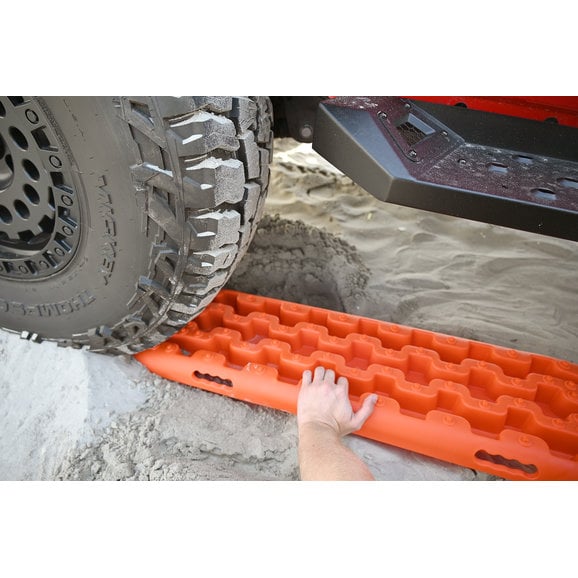
Traction Boards
Traction boards create a surface with improved grip beneath a tire. They are used in sand, snow and mud when a wheel spins without gaining traction. Boards can be lighter and simpler to use than a winch, but they may not help if the vehicle is high-centred on its underbody, deeply bogged down or the tires cannot make proper contact with the boards.
The distinction is straightforward: a winch pulls the vehicle; a rope or strap transfers force from another vehicle; a shackle connects components; a pulley changes the direction and configuration of the pull; and traction boards help the tires regain grip. Recovery equipment should therefore be selected as a compatible system, not on the principle that more metal automatically means better recovery capability.
Working with tensioned cables and straps is hazardous: a line failure or a detached fitting can cause serious injury. Follow the manufacturer’s instructions, use designated recovery points and ensure that trained personnel handle the equipment. The ratings and instructions for each individual component must be observed.
5. Snorkels and Preparation for Difficult Conditions
A snorkel is a raised engine air intake that moves the air-entry point higher than the standard intake location. This can reduce the risk of water entering the engine or of drawing in large amounts of dust in difficult conditions. It is a familiar modification on off-road vehicles, but its benefits are often misunderstood.

A snorkel alone does not turn a vehicle into an amphibious vehicle or guarantee safe passage through deep water. Water can enter through other unsealed components, electrical connections, transmission or axle breathers. The height of electronic modules, condition of seals, exhaust design and the vehicle manufacturer’s specified wading depth also matter.
Preparation for dust, sand, mud and water may include upgraded air filters, underbody protection, mud flaps, sealing of selected connections and regular inspection of hoses and wiring. Every modification must be compatible with the specific model: poorly planned changes to cooling, the air intake or electrical system can create more problems than they solve.
6. Vehicle Protection: From Tires to Armor
Vehicle protection is not a single armor plate but a set of different measures. They can complement one another, but they address different threats: maintaining mobility after tire damage, reducing fragmentation injuries, stopping bullets or providing mine-blast protection.
Run-Flat Systems

Run-flat systems allow a wheel to retain some load-bearing capability for a limited time after the tire loses pressure. Many military systems use a dedicated insert or support ring inside the wheel. If the tire is damaged, the insert partially supports the vehicle’s weight and helps maintain control at a limited speed and over a limited distance.
Run-flat does not mean that a vehicle can continue normal driving indefinitely with a punctured tire. Permitted speed, distance and load depend on the system design, wheel and tire type, and vehicle weight. Manufacturers of military run-flat systems specify different limits for road and off-road use; those figures cannot be applied to other systems without checking compatibility.
Ballistic and Spall Protection
Ballistic armor is designed to protect against specified types of bullets and fragments under a particular standard or test level. A spall liner, including one made from aramid fibers, can reduce the risk of secondary fragments breaking away from the inner surface of armor after an impact. Aramid material alone, however, does not turn an ordinary door into a fully armored door.
Mine protection is a different engineering challenge. It depends on underbody geometry, hull design, energy-absorbing seats, mounting systems and the way blast loads are distributed. Adding metal plates should not be confused with creating a mine-resistant vehicle.
Any armor adds weight. This affects the suspension, brakes, tires, transmission, center of gravity and remaining payload capacity. If a vehicle was not designed for the extra mass, armor can reduce handling and reliability. The modification must be assessed as an engineered system, not as a matter of simply fitting thicker metal.
7. Electronic Warfare and Protection Against Drones
The spread of FPV drones has changed the requirements placed on military transport. A vehicle can be vulnerable not only while moving but also when parked, being repaired or loaded. Some vehicles are therefore fitted with drone-detection equipment, electronic warfare systems, additional antennas, nets and physical protective structures.

Electronic warfare can affect radio-control or navigation links, but its effectiveness depends on the drone type, frequencies, system architecture and operating conditions. It is not a universal ‘shield’ that guarantees protection from every drone. EW equipment also needs power, configuration, compatibility with the vehicle’s own communications and regular maintenance.
FPV drones controlled through fiber-optic cables present a separate challenge. Their control link does not transmit commands over radio waves, so conventional radio-frequency jamming cannot affect it in the same way as a traditional radio link. This increases the importance of other countermeasures and physical protection. A study in Advances in Military Technology examines FPV use and countermeasures based on Ukraine’s combat experience.
Anti-drone nets, grilles and frame structures can create a physical obstacle or change how a drone contacts a vehicle. Their effectiveness depends on the design, the parts of the vehicle covered and the type of threat. They add size, weight and aerodynamic drag, and can make access to hatches, doors, equipment and service points more difficult. They are not merely decorative ‘cope cages’, but engineering compromises that need to be assessed on the specific vehicle.
8. Converting Vehicles for Specialized Roles
Sometimes the most important modification is not an added accessory but a change in the vehicle’s role. A production chassis can become a medical evacuation vehicle, mobile repair workshop, communications post or carrier for specialized equipment.

Medical Evacuation
A medical vehicle needs more than an empty space for a stretcher. It requires secure stretcher restraints, access for medical personnel, dedicated equipment storage, lighting, ventilation, cleanable surfaces and safe crew seating. Ukraine uses a range of platforms as specialized medical vehicles. For example, the Ministry of Defence reported the codification of the armored Kozak-5MED on a Ford F-550 chassis. It can carry four wounded personnel lying down or six seated, in addition to the driver and evacuation team.
Mobile Repair Workshop
A particularly illustrative Ukrainian example is a mobile vehicle repair workshop based on an off-road pickup, approved for use by the Ministry of Defence in July 2024. According to the Ministry of Defence of Ukraine, it is equipped for tire servicing, welding and mechanical work, battery charging and computer diagnostics. Its equipment also includes a 500 kg-capacity crane and a winch rated at five tonnes. Several workshops have already been delivered to combat units. It shows how a pickup can be transformed into a mobile service platform.

Command and Communications Vehicles
In a command vehicle, priorities include communications equipment, antennas, workstations, power supply, document storage and protection of electronics from vibration and dust. The interior must be organized so the crew can work while moving or during short stops without creating a tangle of cables and devices.
Transport for Specialized Equipment
Some vehicles are converted to transport and support unmanned systems, engineering equipment, generators, communications gear or repair kits. Modularity and rapid deployment are particularly important: equipment must be protected while the vehicle is moving yet remain accessible when work needs to begin.
9. Field Modifications: Benefits, Trade-offs and Limitations
Field modifications often arise from a specific need: there is not enough light for repairs, equipment has nowhere secure to go, the standard power supply is insufficient, or the vehicle repeatedly gets stuck on particular routes. In such cases, a simple solution can be highly effective. Every change, however, should be checked for safety and compatibility.
Extra fuel cans, armor, a winch, a second spare wheel, antennas, a protective frame and storage boxes all add weight. They can change axle loads, increase stopping distance, put more stress on the suspension and reduce payload capacity. External structures may catch on branches, restrict access to doors or make narrow passages harder to negotiate. Electrical modifications can overload circuits or cause battery problems if they are installed without proper calculations.
The best configuration is therefore not the one with the most equipment, but the one in which every component has a clear purpose, is securely mounted and does not interfere with other systems. One vehicle may prioritize range and off-road mobility, another protection and evacuation, and a third electrical power and workspace.
Conclusion
A military vehicle becomes effective not because of the number of accessories installed, but because its equipment matches the tasks it must perform. A spare wheel, snorkel, winch, run-flat system, auxiliary power, EW equipment or medical module each addresses a different problem. It is important to understand the capabilities and limitations of each solution, integrate it properly into the base vehicle and account for its effect on weight, reliability and crew safety.
In military transport, even a small detail can matter. A properly secured tool, an accessible first-aid kit, reliable power for a radio or the ability to get out of mud can sometimes affect mission performance as much as complex systems. A vehicle adapted for military use is built from many such carefully considered decisions.
A vehicle and its crew can also express their identity through small interior details. Unit insignia, commemorative symbols and PVC patches can be placed on suitable fabric panels or organizers. A selection is available in the Raccoon Merch PVC patches collection.
From Army Jeep to MRAP: The Evolution of Armored Vehicles
Toyota at War: The History of the Hilux and Land Cruiser in Armed Conflicts
Pickups at War: How a Versatile Vehicle Became Essential to Modern Armies
Structure of Ukraine’s Armed Forces and Defence Forces: From Squad to Corps
From the Rod of Asclepius to the Combat Medic: The History of Military Medicine
What to Give an FPV Pilot - Gift Ideas for an FPV Drone Pilot
What to Give a Commander or Officer - Gift Ideas for a Military Service Member
What to Gift a Soldier: 15 Meaningful Gift Ideas They'll Truly Appreciate