There are firearms companies whose history can be told through individual models. Then there is Browning, whose story is above all the story of one man - John Moses Browning.
His designs became the foundation for firearms manufactured by Winchester, Colt, Remington and Fabrique Nationale. He worked on pistols, rifles, shotguns and machine guns, and some of his designs remain well known more than a century after they were created.
Today, Browning is primarily associated with hunting and sporting firearms. But the history of the brand began long before the brand itself existed - in a small gunsmith's workshop in Ogden, Utah.

John Moses Browning - the beginning of a great story
John Moses Browning was born on January 23, 1855, in Ogden. His father, Jonathan Browning, was a gunsmith, so from an early age the future designer was surrounded by an environment where firearms were not simply used, but built, repaired and improved.
In 1878, at the age of 23, John Browning began working on his first single-shot rifle. On May 12, 1879, he filed a patent application for the design, and on October 7 of the same year, he received U.S. Patent No. 220271.
This design became the first major step in the young gunsmith's career. The rifle attracted the attention of Winchester, which acquired the rights to manufacture it. It later became known as the Winchester Model 1885.
Browning's official historical timeline
The cooperation with Winchester gave Browning the opportunity to work not simply as a gunsmith, but as a professional firearms designer. Over the following decades, his ideas gradually went far beyond a single rifle.
Browning and Winchester
Browning's cooperation with Winchester lasted for roughly two decades and produced a whole series of landmark designs in American firearms history.
They included the Winchester Model 1885, Model 1886, Model 1892, Model 1894, Model 1895 and the Model 1887 shotgun.
For Browning, this was an extremely important period. He gained the opportunity to test new mechanisms and see his designs move from drawings into mass production.
The Winchester Model 1894 became particularly famous. It used a lever-action mechanism and eventually became one of the symbols of American firearms culture.
But Browning did not stop with lever-action systems. He became increasingly interested in automation and in finding ways to use the energy of firing to cycle a firearm.
In 1890, he filed his first patent related to the use of propellant gases to operate a firearm mechanism. This was one of the directions that would eventually lead him toward entirely new automatic systems.
The turn toward Europe and Fabrique Nationale
At the end of the nineteenth century, another extremely important partner entered Browning's story - the Belgian company Fabrique Nationale, or FN.
In 1897, Browning reached an agreement with FN to manufacture one of his self-loading pistols outside the United States. The cooperation proved highly successful and eventually developed into a long-term partnership.
FN became one of the companies most closely associated with Browning's later career.
One of the most important results of this partnership was a self-loading shotgun.
Auto-5 - a revolution in the shotgun world
In 1899, Browning patented the design of a self-loading shotgun. He initially tried to reach an agreement with Winchester, but the two sides could not agree on the terms.
Browning then turned to FN in Belgium.
In 1902, he signed an agreement with Fabrique Nationale to manufacture his new shotgun and personally traveled to Belgium to help establish production.
This was the beginning of the Browning Auto-5.
The shotgun became Browning's first successful self-loading design of its kind and remained in production for almost a century. Browning had so much confidence in the design that he ordered the first 10,000 shotguns for the American market.
Later, because of trade restrictions, production of the American version of the Auto-5 was transferred to Remington. There, the same basic design was produced as the Model 11.
The original Auto-5 remained part of the Browning lineup until the late 1990s. The final Final Tribute series was produced as a farewell to the legendary model.

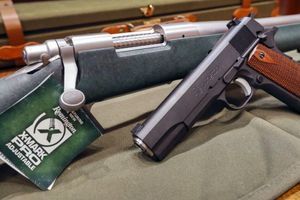
The Colt 1911 - Browning's design under another name
When talking about John Browning, it is impossible to overlook the Colt 1911.
And here it is important to distinguish between the manufacturer and the designer.
The pistol adopted by the U.S. Army in 1911 was designed by John Moses Browning, but manufactured by Colt.
The U.S. military had been testing new pistols since 1906. During the final trials, Browning's design demonstrated exceptional durability. On March 29, 1911, the pistol was officially adopted as the Model 1911.
The history of the 1911 pistol on Browning's official website
The design used a short-recoil system and a locking mechanism that became one of the most influential operating systems in the history of self-loading pistols.
The M1911 remained the standard U.S. military sidearm for decades, serving through World War I and World War II, as well as the Korean and Vietnam Wars.
This is one of the best examples of why Browning's legacy cannot be reduced to the Browning brand alone. He created designs that later became the foundation for products manufactured by other companies.
Browning Automatic Rifle
During World War I, Browning was working on firearms of an entirely different class.
The result was the Browning Automatic Rifle, or BAR M1918.
The U.S. Army ordered the weapon in the context of trench warfare, where soldiers needed an automatic firearm that could be carried and operated by an individual soldier.
The BAR entered U.S. military service in 1918. Over the following decades, the system remained in service, with official American military use continuing into the Vietnam War period.
The history of the Browning BAR
Browning's son, Val Browning, was directly involved in the BAR story. During World War I, he trained American troops in France to use the new weapon.
It is important not to confuse the military BAR M1918 with the modern sporting Browning BAR. The modern hunting rifle is a different design created decades later, although it carries the name and conceptual connection to Browning's famous automatic rifle.
M1917, M1919 and the M2 Browning
Browning did not work only on individual firearms.
His designs became the foundation for an entire family of machine guns.
The M1917 used water cooling, while the M1919 used air cooling. Both systems became important parts of American military equipment during the twentieth century.
But the most famous design was the M2 Browning.
The history of the heavy machine gun began during World War I. Browning worked on a large-caliber machine gun chambered for the .50 BMG cartridge, and further development of the design eventually led to the M2.
The M2 was officially adopted in 1933.
It was mounted on ground vehicles, ships and aircraft. The design proved so durable that it survived several generations of military technology and continues to be used around the world today.

Browning and Ukraine
The M2 Browning is not just a part of American firearms history.
The system is also used by Ukraine's Defense Forces. In 2024, the National Guard of Ukraine reported on training personnel to operate the Browning M2 and its use by mobile fire groups.
For Ukraine, the weapon is particularly interesting because its history began more than a century ago, while the design itself continues to perform practical tasks in modern warfare.
The National Guard also reported the use of the M2 to protect civilian infrastructure from aerial threats.
In this way, Browning's name has also become part of the modern history of firearms in Ukraine.
Hi-Power - another legendary design
Another legendary firearm associated with Browning's name is the Browning Hi-Power.
Its history began during John Moses Browning's lifetime, but the final design was completed by FN engineers after his death.
The pistol was introduced in 1935. One of its defining features was its double-stack magazine, which allowed greater capacity without a corresponding increase in the pistol's overall length.
The Hi-Power became one of the best-known military pistols of the twentieth century and was used in many countries around the world.
Once again, Browning's legacy demonstrated its defining characteristic: his designs continued to live and evolve even after their creator had died.
John Browning's final design
John Moses Browning died on November 26, 1926, in Liège, Belgium.
At the time, he was working on an over-and-under shotgun.
The design became known as the Superposed. After Browning's death, FN engineers completed the project, and the shotgun was introduced to the American market in 1931.
It is interesting that the final chapter of Browning's personal design work was once again connected to FN - the same company with which he had begun working in the late nineteenth century.
How the modern Browning brand developed
After Browning's death, his name did not disappear with the designer.
In 1927, the J.M. & M.S. Browning Company was established in Utah, with Browning Arms Company becoming its subsidiary.
Over the following decades, the company increasingly developed its hunting and sporting firearms business.
In 1965, Browning began working with the Japanese company Miroku. In 1967, the sporting Browning BAR appeared - a completely different design from the military BAR M1918.
During the 1970s, the brand continued expanding its product range, while its connection with FN became even stronger. (browning.com)
This was how the modern image of Browning gradually emerged - a brand that was no longer limited to the military designs of one famous engineer.
Browning today
Today, Browning is primarily associated with hunting and sporting firearms, as well as equipment for outdoor activities.
The brand still offers models that are directly or indirectly connected with its historical legacy.
But the true scale of Browning becomes clear when we look beyond the company's own products.
Winchester manufactured Browning's designs.
Colt produced his M1911.
Remington adapted the Auto-5.
FN worked with Browning for decades and continued developing his designs after his death.
And the M2 Browning became one of the most recognizable heavy machine gun systems of the twentieth century.
John Browning therefore left behind more than a single firearms company. He left an engineering legacy that spread far beyond one brand.
Firearms require proper care
For a designer, the reliability of a mechanism begins with proper engineering. For a firearm owner, that reliability also depends on proper maintenance.
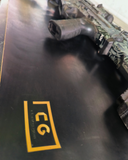
Cleaning a firearm requires a proper work surface where parts do not get lost and the surface is protected from oil, dirt and mechanical damage.
That is why Raccoon Merch offers Clarity Gun firearm cleaning mats.
They provide a practical work surface for cleaning and maintaining firearms at home, at the range or in field conditions.
More than a century ago, Browning created mechanisms that were expected to work reliably. Modern firearm maintenance begins with the same principle - responsible treatment of the equipment.
A legacy that outlived its creator
John Moses Browning died in 1926, but his name remained in history for generations.
He began in his father's small workshop in Ogden and ended his career as one of the most influential firearms designers of his era.
His designs outlived their creator, evolved with technology and continued to serve in completely different countries and armed forces.
That is why the history of Browning cannot simply be viewed as the history of one American brand.
It is the story of a man whose designs influenced Winchester, Colt, Remington, FN and countless other manufacturers.
And perhaps the best way to understand Browning's legacy is through one simple fact: many of his ideas were created more than a century ago, yet their names and operating principles remain recognizable today.
FN Herstal: The History of a Legendary Belgian Firearms Manufacturer
Remington: The History of a Legendary American Firearms Maker
Winchester: The History of a Legendary American Firearm
Heckler & Koch: The History of German Firearms That Became Legendary
Česká zbrojovka: From a 1936 Arms Factory to the CZ BREN 2
Military Intelligence of Ukraine - History, Development and Modern Role
Glock - The History of the Company and the Pistol That Changed Modern Handguns
What to Give a Commander or Officer - Gift Ideas for a Military Service Member
Clarity Gun Rubber Cleaning Mat — Instructions & Care
What to Gift a Soldier: 15 Meaningful Gift Ideas They'll Truly Appreciate