There are companies for which one hundred years feels like an eternity.
And then there is Beretta.
Its documented history begins in 1526, when Bartolomeo Beretta sold 185 arquebus barrels to the Venetian Arsenal. Five centuries later, governments, armies, technologies, and manufacturing methods have changed dramatically, yet the Beretta family has continued working in the same field.
Today, Fabbrica d'Armi Pietro Beretta is recognized as the world's oldest firearms manufacturer. The company has remained under the Beretta family's ownership through 15 generations, while its modern business has grown far beyond a single factory in an Italian mountain valley.
But the most interesting part of Beretta's story is not simply its age.
It is how the company managed to survive five centuries by repeatedly adapting to a changing world.
1526 - Where It All Began
On October 3, 1526, Bartolomeo Beretta da Gardone signed a document that is now considered the oldest surviving written evidence of the Beretta family's involvement in firearms manufacturing.
The Venetian Arsenal ordered 185 arquebus barrels from him.
The value of the order was 296 ducats.
At first glance, this looks like nothing more than an old commercial transaction. But that document became the starting point of Beretta's officially documented history.
Bartolomeo was already an established master craftsman, and his products were apparently good enough to be purchased by the Republic of Venice. Beretta itself therefore considers it likely that the family had already been involved in firearms manufacturing for at least two generations before the 1526 document.
In other words, 1526 was not necessarily the moment when the Beretta family's gunsmithing tradition began.
It is the earliest date for which surviving documentation provides clear evidence.
Beretta - Official Company History
Why Beretta Was Born in Val Trompia
Beretta's history is inseparable from the place where it began.
Gardone Val Trompia lies in a mountain valley near Brescia in northern Italy.
For medieval and early modern manufacturing, the region had many natural advantages.
It had access to metal resources, forests, water, and a long-established tradition of metalworking.
The local rivers could provide mechanical power, while generations of craftsmen developed specialized skills in working with metal and manufacturing weapons.
Beretta therefore did not emerge as an isolated workshop in the middle of the mountains.
It developed within one of Europe's historic centers of arms manufacturing, where skilled craftsmen, materials, technologies, and customers were concentrated in the same region.
That local ecosystem became one of the foundations of the company's future success.
From Barrels to Complete Firearms
During its early centuries, Beretta was particularly known for producing barrels.
This is an important detail that can easily disappear when looking at the modern company.
Today, the Beretta name is associated with complete pistols, shotguns, and other firearms. Historically, however, the company gradually moved from specializing in individual components toward manufacturing complete firearms.
This transition accelerated during the nineteenth century.
Pietro Antonio Beretta, born in 1791, continued developing barrel manufacturing technologies for smoothbore shotguns and pistols.
In 1832, he formally registered the name Fabbrica d'Armi Pietro Beretta.
The business was entering a new phase.
Beretta was becoming something much closer to an industrial enterprise than the traditional workshop it had once been.
The 19th Century - Tradition Becomes a Business
The following generations did not simply preserve the old methods. They continued modernizing the company.
Giuseppe Antonio Beretta expanded production capabilities, introduced new technologies, and invested in improved equipment.
The commercial side of the business also became increasingly important.
Beretta began expanding its international markets and developing broader distribution networks.
By the end of the nineteenth century, the company had much more in common with a modern industrial manufacturer than with the small gunsmithing workshops of previous centuries.
This is where one of the defining characteristics of Beretta's history becomes particularly clear:
the tradition remained, but the way the company worked constantly changed.
Pietro Beretta and the Industrial Era
The beginning of the twentieth century brought another major transformation.
Pietro Beretta, who led the company during this period, pushed modernization and introduced more advanced manufacturing technologies.
Instead of relying entirely on the skills of individual craftsmen, Beretta increasingly focused on scaling production, adopting modern machinery, standardizing processes, and developing patented technologies.
The result was significant.
A company that had around 130 employees eventually grew to approximately 1,500.
Beretta was becoming not simply a famous Italian gunsmithing company, but a modern industrial manufacturer.
This period also saw the company expand into new categories of firearms.
Among the important models of the era was the Model 1915, adopted by the Italian military, followed later by models such as the Model 1918 and MAB 1938.
This was the moment when Beretta's centuries-old manufacturing tradition fully entered the industrial age.

World War I and the New Beretta
The First World War transformed European industry.
For Beretta, it became both a period of large-scale military production and technological acceleration.
Military requirements were changing.
Traditional firearms remained important, but the twentieth century was increasingly moving toward more compact and mechanically sophisticated weapons.
Beretta responded by expanding into new categories.
The Model 1915 became an important step in the company's development of military pistols. Later, the company produced automatic firearms, including the famous MAB 1938.
Beretta was no longer simply adapting existing manufacturing traditions.
It had become a company capable of developing and producing several different categories of military firearms.
Beretta During World War II
The Second World War once again placed the company's production largely on a military footing.
Beretta manufactured firearms for the Italian armed forces and other customers, while the MAB 1938 became one of the company's best-known firearms of the period.
But the most important aspect of this period was not simply production volume.
The war demonstrated how far Beretta had moved from the small workshop of the sixteenth century.
The company now possessed industrial infrastructure, technological expertise, and experience with large-scale manufacturing.
After the war, however, another question emerged:
What happens when the world no longer needs the same level of military production?

After the War - Returning to the Civilian Market
Postwar Europe was a very different place.
Beretta once again had to adapt.
Hunting and sporting firearms became increasingly important areas of the business. The company expanded its presence in civilian markets and became strongly associated with hunting and competitive shooting.
The company's SO series of over-and-under shotguns, introduced in the twentieth century, eventually became an important symbol of high-end Italian gunmaking.
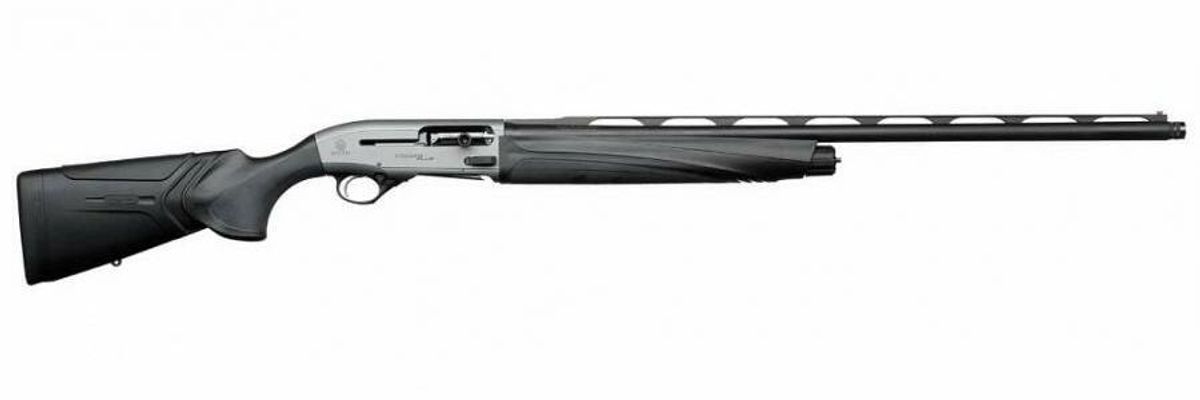
Other significant developments followed, including the S55 and the A300 semi-automatic shotgun.
This was an important transformation.
Beretta was no longer a company whose future depended primarily on military contracts.
It was developing a broader ecosystem around shooting sports, hunting, and outdoor culture.
Beretta 92 - The Model That Changed the Company's Scale
In 1975, Beretta introduced the Model 92.
At first, it was simply another new pistol in the company's long history.
It eventually became one of the most recognizable Beretta firearms ever produced.
The major turning point came in 1985.
Following a competition for the United States military, Beretta received a contract for pistols that were designated M9 by the U.S. armed forces.
The decision transformed Beretta's visibility in the international market.
The United States was one of the world's most important firearms markets, and supplying the U.S. military gave Beretta enormous global exposure.
According to the company, production of the 90 Series eventually exceeded four million units.
Beretta was no longer simply a historic Italian firearms manufacturer.
It had become a global brand.

Beretta Goes Global
The American market became so important that Beretta established a dedicated U.S. operation.
This was a strategic step that reflected a new model of international expansion.
Beretta could no longer remain simply an Italian manufacturer exporting products around the world.
It was becoming an international company with manufacturing, commercial, and corporate operations in multiple markets.
This globalization became one of the factors that helped the company remain competitive through the late twentieth and early twenty-first centuries.
From Beretta to Beretta Holding
Another major transformation came in 1994 with the creation of Beretta Holding.
The business was no longer simply a single company manufacturing firearms under one name.
Beretta Holding began bringing together companies and brands connected with firearms, ammunition, optics, outdoor equipment, and sporting activities.
Today, the group includes brands such as Benelli, Sako, Tikka, Steiner, Burris, Franchi, Stoeger, Norma, RWS, and Holland & Holland.
A particularly important development came in 2022, when Beretta Holding acquired RUAG Ammotec, a major European ammunition manufacturer.
The story of Beretta had therefore evolved into the story of an international industrial group.
Beretta Holding - The Beretta Group

Beretta Today
The modern Fabbrica d'Armi Pietro Beretta is dramatically different from Bartolomeo Beretta's workshop in sixteenth-century Italy.
But one characteristic remains the same - constant adaptation.
Today, the company produces firearms for civilian and military markets, hunting, sport shooting, and tactical applications, while also developing clothing, accessories, and other products connected with outdoor activities.
According to current company information, Beretta employs around 937 people, holds more than 200 active patents, and has production capacity of approximately 1,500 firearms per day.
The scale of the transformation is remarkable.
From a craftsman supplying 185 barrels to the Venetian Arsenal in 1526 to a modern manufacturer with international operations, hundreds of patents, and industrial-scale production.
Firearms Are More Than Manufacturing
Beretta's history also illustrates an important principle: a firearm's lifecycle does not end when it leaves the factory.
Proper storage, maintenance, organization, and responsible handling are all part of firearm ownership.
For anyone who regularly cleans and maintains firearms, the working surface is also an important part of the setup.
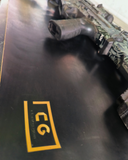
This is where Clarity Gun cleaning mats from Raccoon Merch fit naturally into the picture.
They are designed to organize the workspace during firearm cleaning, helping protect the surface from oils and dirt while providing a stable working area that can be cleaned after use.
The Clarity Gun line includes different sizes for different working environments - from compact setups for handguns to larger surfaces suitable for more extensive maintenance work.
It is another part of the same culture: while companies such as Beretta have spent centuries developing firearm manufacturing technology, responsible owners also have a role in caring for and maintaining their equipment.
Clarity Gun - Firearm Cleaning Mats
The Beretta Logo
There is another interesting detail that demonstrates how strongly Beretta has developed into a global brand.
The company's famous three-arrow logo emerged during the twentieth century.
In 1923, Italian poet Gabriele D'Annunzio proposed the motto "dare in brocca", an expression associated with hitting a target.
The symbol featuring three arrows passing through three circles eventually became one of Beretta's most recognizable visual elements.
It became the company's official logo in 1949.
It is more than just a manufacturer's mark.
Behind it stands a history that was already more than four centuries old when the logo was adopted.
What Is the Secret of Beretta?
Perhaps the most interesting question about Beretta is not "How did the company survive for 500 years?" but rather "How did it change enough to survive for 500 years?"
Beretta has lived through:
-
the Republic of Venice;
-
the Napoleonic Wars;
-
the unification of Italy;
-
the Industrial Revolution;
-
two World Wars;
-
the transition from craftsmanship to mass production;
-
the emergence of new firearm technologies;
-
globalization;
-
major changes in civilian and military markets.
And each time, the company adapted to its environment.
It began by specializing in barrels.
Then it moved into complete firearms.
It developed industrial-scale manufacturing.
It expanded into pistols and automatic firearms.
After World War II, it strengthened its civilian and sporting businesses.
It expanded into the American market.
And in the modern era, it became part of a major international group.
Beretta did not preserve one specific technology.
It preserved the ability to manufacture firearms and adapt to a changing era.
Five Centuries Between Tradition and Innovation
Beretta is a rare example of a company for which tradition does not mean rejecting change.
Quite the opposite.
Its history demonstrates that a long-lasting business can survive only when tradition becomes a foundation for innovation rather than a substitute for it.
In 1526, Bartolomeo Beretta supplied barrels for arquebuses to Venice.
Centuries later, his descendants were producing pistols, shotguns, and military firearms using industrial manufacturing methods.
Today, Beretta is part of a large international group operating across firearms, ammunition, optics, outdoor products, and sporting markets.
Five centuries later, the name remains the same.
The company itself, however, has changed almost completely.
And that may be the real secret of Beretta:
to preserve a tradition for five centuries, it had to keep changing.
Clarity Gun Rubber Cleaning Mat — Instructions & Care
What to Gift a Soldier: 15 Meaningful Gift Ideas They'll Truly Appreciate
What to Give a Commander or Officer - Gift Ideas for a Military Service Member
Personal Body Armor: History, Evolution and the Path from Chainmail to Modern Plate Carriers
Colt: The History of the Company That Changed the World of Firearms
Glock - The History of the Company and the Pistol That Changed Modern Handguns