Some firearms remain well known for a single generation.
Others survive for decades, influence military doctrine, go through wars, receive countless modifications and eventually become an entire family of firearms.
The AR family belongs to the second category.
Its story began in the 1950s with a relatively small American company called ArmaLite and designer Eugene Stoner. First came the AR-10 chambered for 7.62×51 mm, followed by the AR-15 and its smaller-caliber cartridge. After the design was transferred to Colt, its military history took another major turn with the development of the M16. Later came the M4, while the underlying AR architecture became the basis for a huge number of military and civilian rifles.
Today, a member of this family is also part of Ukraine's modern military small-arms landscape - the UAR-15.
This is not simply the story of one rifle. It is the story of a design idea that proved so adaptable that it has continued to evolve for more than seven decades.
ArmaLite - Where the Story Began
ArmaLite was established in 1954 as a division of Fairchild Engine and Airplane Corporation. The company focused on developing lightweight firearms and experimented extensively with new materials and construction methods.
One of the central figures in ArmaLite's history was Eugene Stoner, an American designer who became one of the most influential firearms engineers of the 20th century.
Stoner's approach differed from the traditional design philosophy of the period.
Rather than simply improving existing firearms, he tried to rethink the military rifle itself: make it lighter, more efficient and more technologically advanced.
It was at ArmaLite that the AR-10 and AR-15 were developed - two designs that would become the foundation of the future AR family.
And there is one important detail to remember.
AR stands for ArmaLite Rifle.
It was not originally an abbreviation for "assault rifle", as is sometimes mistakenly assumed. The name came directly from ArmaLite.

The AR-10 - The First Major Step
Before the AR-15, Stoner worked on the AR-10.
It was a rifle chambered for the powerful 7.62×51 mm cartridge - the same general class of ammunition that was becoming the standard for many Western military rifles at the time.
The AR-10 was highly unconventional for its era.
Its design made extensive use of lightweight materials, including aluminum alloys. Stoner wanted to reduce the weight of the rifle while maintaining the durability required for military service.
The AR-10 became an important technological experiment. Its design combined a lightweight receiver, unusual overall configuration, a gas-operated action and a rotating bolt.
The AR-10 did not become the standard rifle of the U.S. Army.
But its importance turned out to be much greater than the number of rifles produced might suggest.
The experience gained during its development became the foundation for the AR-15.
That is why the history of the M16 and modern AR platforms is better understood by starting with the AR-10.

Why Was the AR-15 Created?
During the 1950s, the U.S. military became increasingly interested in the idea of a lightweight rifle chambered for a smaller, high-velocity cartridge.
The concept was quite radical.
Instead of a relatively heavy battle rifle chambered for 7.62 mm ammunition, the idea was to use a much lighter system firing a smaller cartridge.
For a soldier, this meant reduced weapon weight and lighter ammunition, which could reduce the overall load carried during movement.
In 1957, ArmaLite presented the AR-15.
Its design was closely related to the experience gained with the AR-10, but it was adapted for a much smaller cartridge. The initial development involved .222 Remington, followed by .223 Remington.
The AR-15 retained several of the core principles of the AR-10 - a lightweight architecture, a receiver divided into upper and lower sections, a gas-operated system and a rotating bolt.
But now these ideas were incorporated into a much lighter firearm.
The combination of low weight, a new cartridge and an unconventional design made the AR-15 increasingly interesting to the U.S. military.
Colt and the Second Life of the AR-15
In the late 1950s, ArmaLite transferred the rights to the AR-15 to Colt.
This was a turning point.
ArmaLite remained the company behind the original design, but Colt now had the opportunity to manufacture the rifle on a much larger scale, promote it to military customers and continue developing the platform.
We have also covered the company itself in our article about the history of Colt and the company that changed the firearms world.
For the AR-15, the move to Colt effectively meant a new beginning.
The rifle was no longer simply a promising project developed by a relatively small engineering company.
It now had a major industrial manufacturer capable of promoting the design to the U.S. military.
At the same time, a major debate was taking place in the United States over the future of infantry small arms.
On one side was the established M14 and its 7.62 mm cartridge.
On the other was the new lightweight AR-15 and its smaller-caliber ammunition.
Gradually, the advantages of the lightweight concept became increasingly difficult to ignore.
The AR-15 Becomes the M16
During the 1960s, the situation changed decisively.
The AR-15 began entering U.S. military service, and its military development eventually became the M16.
During the 1960s, the M16 became one of the principal American military rifles and saw extensive use during the Vietnam War.
But the transition was not simple.
The first years of M16 service were accompanied by serious reliability problems. The causes were complex and involved not only the design itself, but also ammunition, operating conditions and decisions made during the weapon's introduction.
The system was subsequently improved.
The history of the early M16 became an important lesson in military procurement: a promising firearm design also requires appropriate testing, compatible ammunition, maintenance procedures and proper training.
The M16 continued to evolve and remained in service for decades.

The M16 Was More Than Just an AR-15
It is important not to treat the AR-15 and M16 as exactly the same firearm.
They share a common lineage, but they are not identical.
The AR-15 was the original ArmaLite design later developed by Colt.
The M16 was a military rifle based on that design and adapted to U.S. military requirements.
Over the following decades, the M16 was continuously modernized.
The family included the M16A1, M16A2, M16A3, M16A4 and other variants.
Materials, sights, configuration and other characteristics changed over time.
The basic concept, however, remained recognizable.
That is one of the main reasons for the longevity of the family.
The M4 - A Shorter Branch of the Same Story
The next major step was the M4 carbine.
While the M16 was a full-length military rifle, the M4 was developed as a more compact version of the same general concept.
The carbine continued the M16 design philosophy while offering reduced dimensions and greater convenience in situations where a shorter firearm was useful.
During the 1990s, the M4 increasingly became an important part of U.S. military small arms.
The later M4A1 introduced further changes and refinements.
Another major branch of the AR family had emerged.
AR-10 → AR-15 → M16 → M4.
But the evolution did not stop there.

How the AR Became an Entire Family
Perhaps the most remarkable part of the AR story is how far the design moved beyond its original ArmaLite roots.
Today, the term "AR platform" can refer to a huge variety of rifles and carbines.
Different barrel lengths, calibers, configurations and manufacturers appeared over the decades.
Yet the basic architecture remained recognizable.
That is why the history of the AR is no longer simply the history of one company.
ArmaLite created the original design.
Colt turned it into a large-scale military platform.
The U.S. military developed it into the M16.
The M4 developed the compact carbine concept.
And manufacturers around the world continued creating their own versions.
In this sense, the AR became more than a firearm model.
It became an engineering platform.
Why Has the AR Platform Lasted So Long?
There are several reasons.
First, the underlying design concept proved adaptable.
Second, it could be continuously modernized.
Instead of creating an entirely new rifle every time requirements changed, manufacturers could continue developing an established architecture.
Third, the enormous number of users and manufacturers created a large ecosystem of experience and development.
The result is a cycle:
adoption → experience → modernization → new models → wider adoption.
That is why a design whose roots go back to the 1950s is still being developed today.
The AR Platform Comes to Ukraine
For us, this part of the story is especially interesting because the AR platform has long since ceased to be exclusively American.
Ukraine has also developed its own version of the concept - the UAR-15.
The Ukrainian rifle is based on the AR-15 architecture and chambered for the 5.56×45 mm NATO cartridge.
In 2023, the UAR-15 was adopted for service by the Armed Forces of Ukraine.
And this is a particularly symbolic point in the story.
A design that began at the American ArmaLite company in the middle of the 20th century eventually received a Ukrainian continuation after decades of development.
The UAR-15 - A Ukrainian Chapter in the AR Story
The appearance of the UAR-15 is important not simply because another rifle entered Ukrainian service.
It also reflects a broader change in Ukrainian small arms.
For decades, Soviet and post-Soviet small arms in Ukraine were dominated by weapons based on the AK family.
As Ukraine moved toward NATO standards, the country began receiving increasing numbers of Western-designed firearms while also developing domestic weapons chambered for NATO-standard ammunition.
The UAR-15 became one example of this transition.
Its development also shows how far the modern AR platform has moved from the original AR-15.
More than half a century of engineering development separates the early ArmaLite design from the Ukrainian UAR-15.
The family connection, however, remains clear.

From the AR-10 to the UAR-15 - One Long Story
When viewed as a whole, the story is remarkable.
In the 1950s, Eugene Stoner worked at ArmaLite on a new concept for lightweight military firearms.
The AR-10 appeared.
The AR-15 followed.
ArmaLite transferred the rights to Colt.
The AR-15 entered the American military world.
The M16 emerged.
Later came the M4.
The architecture spread far beyond the United States.
Manufacturers around the world continued developing their own versions.
And eventually, one branch of this design family appeared in Ukrainian military service as the UAR-15.
AR-10 → AR-15 → M16 → M4 → UAR-15.
These are not five identical rifles.
They represent a line of technological inheritance.
Firearms Change, but Maintenance Remains Important
There is another interesting aspect to this story.
Over seven decades, firearms changed dramatically.
Steel was supplemented or replaced by aluminum alloys and polymers.
Designs became lighter.
Modular systems, modern sights and new manufacturing technologies appeared.
But one thing remained unchanged: complex mechanical systems require proper care and maintenance.
That is why firearms development has always been accompanied by a culture of responsible maintenance.
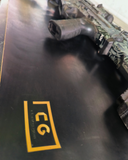
For organizing a dedicated workspace, Raccoon Merch offers the Clarity Gun firearm cleaning mat.
The Legacy of ArmaLite
ArmaLite did not become the world's largest firearms manufacturer.
Its history could easily have remained a relatively obscure chapter in the story of American arms manufacturing.
But that is not what happened.
A relatively small company created a design that outlived its original manufacturer.
The AR-10 became the foundation for the AR-15.
The AR-15 evolved into the M16.
The M16 led to the M4.
And the AR architecture spread around the world, continuing to evolve into new firearms.
Among them is the Ukrainian UAR-15.
The history of ArmaLite is therefore a good example of how the importance of an engineering idea is not always measured by how many units were produced during its first years.
Sometimes the most important question is how long the idea itself survives.
And the ArmaLite idea has now survived for more than seven decades.
Browning: The History of a Legendary American Firearms Manufacturer
FN Herstal: The History of a Legendary Belgian Firearms Manufacturer
Remington: The History of a Legendary American Firearms Maker
Česká zbrojovka: From a 1936 Arms Factory to the CZ BREN 2
Military Intelligence of Ukraine - History, Development and Modern Role
Glock - The History of the Company and the Pistol That Changed Modern Handguns
What to Give a Commander or Officer - Gift Ideas for a Military Service Member
Clarity Gun Rubber Cleaning Mat — Instructions & Care
What to Gift a Soldier: 15 Meaningful Gift Ideas They'll Truly Appreciate