Modern tactical medicine is the result of decades of combat experience, medical research, and lessons learned on the battlefield. One of its fundamental principles is the MARCH protocol - a structured approach that helps prioritize life-threatening conditions when caring for casualties in combat.
Today, the acronym MARCH is familiar to military personnel, combat medics, tactical medicine instructors, and thousands of people who have completed modern first aid and Tactical Combat Casualty Care (TCCC) training.
MARCH is far more than just a mnemonic. It is a logical system developed through years of analyzing battlefield casualties and identifying the most effective priorities for saving lives. It continues to evolve alongside advances in medicine and operational experience.
What Does MARCH Stand For?
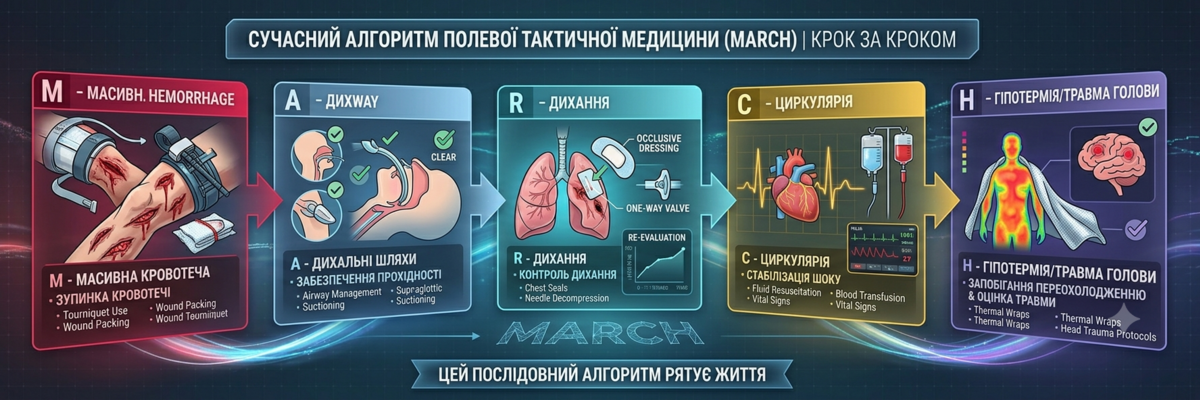
Each letter in MARCH represents one category of life-threatening conditions that should be assessed in priority order.
-
M - Massive Hemorrhage
-
A - Airway
-
R - Respiration
-
C - Circulation
-
H - Hypothermia / Head Injury
This sequence forms the foundation of modern tactical medicine by focusing first on the conditions most likely to cause preventable death if left untreated.
Why Is the Order So Important?
For decades, military physicians and researchers studied the causes of preventable deaths on the battlefield.
Their findings showed that many casualties might have survived if the most critical problems had been identified and addressed in the proper sequence.
That is why massive bleeding comes first in the MARCH protocol. Severe hemorrhage can become fatal within minutes, making it the highest priority before moving on to other life-threatening conditions.
This systematic approach has made battlefield casualty care more organized, more effective, and easier to teach across military organizations worldwide.
The History of the MARCH Protocol
The origins of MARCH are closely connected with the development of Tactical Combat Casualty Care (TCCC).
In the 1990s, U.S. military medical experts began carefully studying combat casualty data to understand why preventable deaths continued to occur on the battlefield.
The experiences gained during conflicts in Iraq and Afghanistan confirmed the value of prioritizing treatment according to the most immediate threats to life. These lessons eventually shaped what is now known as the MARCH protocol, which became one of the cornerstones of modern tactical medicine.
Today, MARCH is taught by military organizations, medical instructors, and training centers across many countries.
Why Has MARCH Saved So Many Lives?
The strength of the MARCH protocol lies not in individual medical interventions but in its clear system of priorities.
Rather than treating injuries randomly, MARCH guides responders to focus first on the conditions that present the greatest immediate danger.
This structured decision-making process has significantly improved battlefield casualty care and has become a key element of modern military medical training.
Its principles are also widely used by emergency response organizations and rescue services outside the military.
Ukraine and the Evolution of Modern Tactical Medicine
Russia's full-scale invasion has placed Ukraine at the forefront of modern tactical medicine.
Combat medics, instructors, military physicians, volunteers, and soldiers work every day under extremely challenging conditions, gaining practical experience that is difficult to replicate anywhere else.
Today, Ukraine is making a significant contribution to the ongoing development of tactical medicine. The experience of Ukrainian professionals is being studied internationally, while lessons learned from the battlefield continue to influence training methods, educational programs, and professional discussions around the world.
Behind every improvement are people whose daily mission is to save lives.
Tourniquets and Trauma Shears - Symbols of Modern Tactical Medicine
Some pieces of equipment have become instantly recognizable.
The tourniquet and trauma shears are no longer seen merely as medical tools. They have become symbols of combat medics, tactical medicine instructors, emergency responders, and everyone dedicated to saving lives.
These items appear on training courses, in military medical kits, and throughout the tactical medicine community.
The Development of Tourniquet and Trauma Shear Retention Systems
As tactical medicine evolved, so did the equipment that supports it.
Modern retention systems and holders were developed to keep tourniquets and trauma shears securely attached to gear while allowing quick access when needed.
Manufacturers continue improving these solutions by experimenting with new materials, mounting systems, and designs that increase durability, reliability, and ease of use in demanding environments.
"Tourniquet" and "Trauma Shears" PVC Patches
As the tactical medicine community has grown, so has its visual identity.
This inspired the creation of our Tourniquet and Trauma Shears PVC patches.
These patches are not functional medical equipment. Instead, they represent belonging to a community of combat medics, instructors, military personnel, and everyone who values tactical medicine and life-saving skills.
For some, they commemorate completed training. For others, they symbolize a profession, a calling, or respect for those who save lives every day.
"Tourniquet" and "Trauma Shears" Jewelry
Symbols do not have to exist only on uniforms or tactical gear.
That is why we created our Tourniquet and Trauma Shears jewelry pieces.
Designed for combat medics, instructors, military personnel, and supporters of tactical medicine, they represent dedication, professionalism, and respect for the people who stand between injury and survival.
Interesting Facts About the MARCH Protocol
-
MARCH is a core component of Tactical Combat Casualty Care (TCCC).
-
It is taught by military organizations in many countries around the world.
-
Its principles are also used by emergency response and rescue services.
-
The protocol continues to evolve through ongoing medical research and operational experience.
-
Ukrainian combat medics and instructors are making valuable contributions to the future development of tactical medicine.
Conclusion
The MARCH protocol is much more than an acronym.
It represents decades of work by physicians, researchers, military instructors, and combat medics striving to improve battlefield survival.
As tactical medicine continues to evolve, new equipment, better training, and updated medical knowledge continue to improve casualty care.
Yet the ultimate goal remains unchanged: saving lives.
That is why symbols such as the tourniquet and trauma shears hold special meaning today. They represent not only essential equipment but also the people whose knowledge, skill, and commitment make survival possible.
Related Articles
If you're interested in tactical medicine and military equipment, you may also enjoy: