
Trauma Shears: History, Purpose, and Why They Have Become a Symbol of Modern Tactical Medicine
Among all the equipment used by combat medics, paramedics, and tactical medicine instructors, there is one tool that is instantly recognizable to almost everyone: trauma shears.
At first glance, they may look like ordinary scissors with an unusual shape. In reality, however, their design reflects decades of development in emergency medicine, the experience of countless medical professionals, and one essential goal - providing rapid access to injuries while minimizing the risk of causing additional harm to the patient.
Today, trauma shears are a standard component of modern military first aid kits. They are carried by combat medics, paramedics, emergency medical personnel, firefighters, and rescue teams, and have become one of the most recognizable symbols of modern tactical medicine.
The History of Trauma Shears
Before specialized trauma shears were developed, medical professionals often relied on ordinary scissors or knives to remove clothing from injured patients. This process was slower and increased the risk of accidentally cutting or injuring the patient's skin.
During the second half of the 20th century, the first dedicated trauma shears were introduced. Their primary purpose was to allow medical personnel to cut through clothing, gear, and dressings quickly while reducing the risk of further injury.
Initially adopted by emergency medical services, trauma shears soon became standard equipment in military medicine as well. Today, they can be found in nearly every combat medic's medical kit around the world.
Why Are They Called "Trauma Shears"?
The name can be misleading.
The word "atraumatic" does not mean they cannot cause injury. Instead, it refers to their design, which helps minimize the risk of additional trauma while exposing an injury.
Their signature rounded lower tip slides safely beneath clothing and equipment, allowing medical personnel to cut fabric without the sharp point contacting the patient's skin.
This simple but highly effective feature is what gives trauma shears their name.
Why Do Trauma Shears Have Such a Unique Shape?
Every element of their design serves a practical purpose.
Rounded Blunt Tip
The rounded lower blade helps slide beneath clothing while reducing the chance of accidentally puncturing or cutting the patient's skin.
Long Blades
Long cutting edges make it possible to remove large sections of clothing quickly.
Serrated Blade
The serrated edge grips slippery or heavy fabrics, preventing them from sliding between the blades.
Reinforced Pivot
The central joint is designed to withstand much greater force than ordinary scissors, allowing them to cut through thick materials.
Ergonomic Handles
Large finger loops make the shears comfortable to use, even while wearing tactical or medical gloves.
Stainless Steel Construction
High-quality trauma shears are made from corrosion-resistant stainless steel designed to withstand moisture, repeated cleaning, and years of professional use.
What Can Trauma Shears Cut?
Despite common misconceptions, trauma shears are designed for much more than cutting bandages.
Quality trauma shears can cut through:
-
military uniforms;
-
winter jackets;
-
belts and straps;
-
bandages and dressings;
-
heavy fabrics;
-
certain plastic components of tactical equipment;
-
footwear when necessary to access an injury.
Their versatility has made them indispensable in both civilian emergency medicine and military operations.
An Essential Part of Every Military First Aid Kit
Modern tactical medicine is built around speed.
To properly assess a casualty or apply a tourniquet, medical personnel often need immediate access to the wound. Trauma shears make this possible by allowing clothing and equipment to be removed quickly and efficiently.
Today, trauma shears are included in recommended military first aid kits and have become standard equipment for combat medics, tactical medicine instructors, and many soldiers.
Combat Medics and Tactical Medicine Instructors - The People Who Save Lives
Behind every pair of trauma shears is a person prepared to act when seconds matter.
Combat medics, paramedics, tactical medicine instructors, and volunteers perform an extraordinary job every day. They teach life-saving skills, share practical experience, refine medical procedures, and help save lives both on and off the battlefield.
Throughout the years of full-scale war, Ukraine has gained an exceptional amount of practical experience in tactical medicine. Many approaches to casualty care, medical training, and evacuation developed by Ukrainian professionals are now being studied internationally.
Thanks to these dedicated individuals, tactical medicine has become an essential part of the training and culture of today's Ukrainian Armed Forces.
How to Care for Trauma Shears
Even the highest-quality trauma shears require basic maintenance.
Simple recommendations include:
-
clean them after use;
-
disinfect them when appropriate;
-
dry them thoroughly before storage;
-
avoid using them as general-purpose household scissors;
-
periodically inspect the blades and pivot for wear.
Proper maintenance helps ensure that trauma shears remain reliable for years.
Why Do High-Quality Trauma Shears Cost More?
At first glance, many trauma shears appear almost identical.
However, the difference between inexpensive and professional-grade models lies in the details.
Higher-quality trauma shears generally feature:
-
better stainless steel;
-
stronger and longer-lasting pivot mechanisms;
-
improved ergonomics;
-
corrosion-resistant protective coatings;
-
consistent cutting performance after extended use.
When a tool may be needed in a life-threatening situation, reliability is worth the investment.
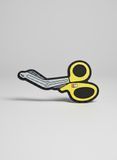
The "Trauma Shears" Patch by Raccoon Merch
For many soldiers, combat medics, tactical medicine instructors, and medical professionals, trauma shears have become more than just a tool—they have become a symbol of their profession.
That is why we created the "Trauma Shears" patch.
It is not intended as functional equipment or medical identification. Instead, it is a designer patch representing membership in a community of people for whom tactical medicine has become an important part of life, service, or professional identity.
Sterling Silver "Trauma Shears" Pendant
Alongside the patch, Raccoon Merch also created a sterling silver Trauma Shears Pendant.
For some, it is an unusual piece of jewelry.
For others, it represents responsibility, professionalism, and respect for those who dedicate themselves to saving lives.
It is worn by combat medics, tactical medicine instructors, paramedics, volunteers, and people who want to honor those working in emergency and battlefield medicine.
Interesting Facts
-
Most trauma shears are approximately 18-19 cm (7-7.5 inches) long.
-
They are widely used by military personnel, emergency medical services, firefighters, police officers, and search-and-rescue teams.
-
The rounded lower tip was specifically designed to reduce the risk of accidentally injuring the patient while cutting clothing.
-
Many modern trauma shears feature matte black coatings that improve corrosion resistance while reducing unwanted reflections.
Conclusion
Trauma shears are much more than a medical instrument.
Over decades of development in emergency and tactical medicine, they have become a symbol of readiness, professionalism, and the willingness to act when every second counts.
Today they are found in military medical kits, emergency response bags, ambulances, and rescue equipment across the world.
Most importantly, behind every pair of trauma shears stands a person prepared to help another human being during one of the most difficult moments of their life. That is exactly why we created our Trauma Shears patch and sterling silver pendant—to honor the people who make that commitment every single day.
Related Articles
- Military First Aid Kit (IFAK): What It Contains and Why It Saves Lives
- The MARCH Protocol: The Foundation of Modern Tactical Medicine
- Tourniquets: History, Development, and Importance
- The History of Military Dog Tags: From Identification to a Symbol of Military Service
- 15 Gift Ideas for Soldiers They Will Truly Appreciate
-
What to Give a Military Medic: 17 Gift Ideas for Combat Medics, Paramedics and Tactical Medics