When people talk about Smith & Wesson today, they usually think of revolvers, .357 Magnum, .44 Magnum, or the famous Model 29. But the company's history began long before Magnum - at a time when the very idea of the modern metallic cartridge was still taking shape.
Smith & Wesson went from early experiments with repeating firearms to becoming one of the best-known American manufacturers of handguns. During that time, cartridges, mechanisms, materials, and the very role of the handgun all changed.
This is not simply the story of individual models. It is the story of how handguns gradually entered a new technological era.
Two Gunmakers from New England
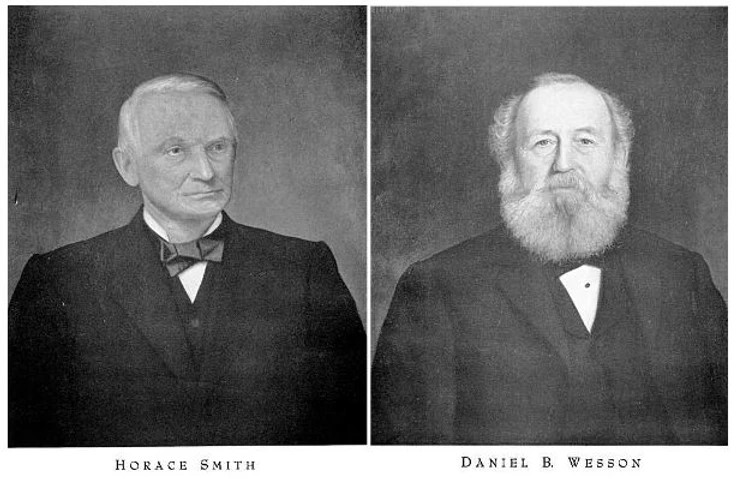
The history of Smith & Wesson began with Horace Smith and Daniel B. Wesson.
In 1852, they joined forces to develop a repeating firearm that could use a self-contained cartridge. At the time, this was a highly ambitious idea.
Traditional firearms still largely relied on separate loading of powder, bullet, and percussion cap. Smith and Wesson wanted to simplify the process: the shooter would have a ready-made cartridge that could be quickly loaded into the firearm.
Their first major attempt was a repeating firearm with a lever mechanism and tubular magazine known as the Volcanic.
Although the project itself did not become a major commercial success, it became an important step in the careers of both inventors.
Volcanic - The Failed Project That Led to Winchester
The Volcanic was an interesting technological concept, but the business behind it struggled.
In 1855, Horace Smith sold his interest, and Oliver Winchester became involved with the company. In 1856, Winchester and John M. Davies acquired the bankrupt company and reorganized it. The enterprise eventually developed into Winchester Repeating Arms.
This creates an interesting twist in the history of American firearms: an early business venture involving Smith and Wesson became one of the predecessors of the future Winchester company.
Smith and Wesson, however, did not stop working on firearms.
They returned to the idea of a compact firearm using a metallic cartridge - but this time they focused on a revolver.

A New Beginning and the Rollin White Patent
In 1856, the history of the company that would become Smith & Wesson began in Springfield, Massachusetts. Daniel Wesson was working on a revolver designed to use ready-made cartridges. Library of Congress - Smith & Wesson history
A key part of this development was the patent of Rollin White.
His design featured a cylinder with chambers bored all the way through. This allowed cartridges to be loaded from the rear of the cylinder rather than from the front.
For Smith & Wesson, this technology was extremely important.
The company obtained rights to use White's patent in its revolvers, giving it a strong position during an important transition in revolver design.
The Smithsonian preserves a patent model associated with Rollin White's invention, providing a physical link to this early stage of Smith & Wesson's history.
Model 1 - The Small Revolver That Changed the Market
In 1857, Smith & Wesson introduced the Model 1.
It was a small seven-shot revolver chambered in .22 rimfire. By modern standards, it looks simple and compact, but at the time it represented an important technological change.
Its significance was not its size or power.
It used a ready-made metallic cartridge.
Instead of separately measuring powder and loading a projectile and percussion cap, the shooter could use a complete cartridge. This made the loading process much simpler.
The concept would eventually become fundamental to modern cartridge firearms.
Demand for the Model 1 was extremely strong. By 1860, orders exceeded the factory's production capacity. Library of Congress - Smith & Wesson history
For Smith & Wesson, this was the moment when an experimental technology became a successful commercial product.
Smith & Wesson During the American Civil War
During the American Civil War, Smith & Wesson revolvers were purchased by servicemen of different ranks on both sides.
They were primarily privately purchased firearms rather than a single standard handgun issued throughout the armies. Library of Congress - Smith & Wesson history
Their compact size made them useful as additional personal weapons.
After the war, however, Smith & Wesson began looking beyond small pocket revolvers.
The American frontier created demand for larger and more powerful firearms, opening a new chapter in the company's development.
Model 3 - Moving Into the Big-Bore Era
In 1870, Smith & Wesson introduced the Model 3 American.
This was a very different revolver from the company's early pocket models. It featured a large frame, centerfire ammunition, and a .44 caliber cartridge.
Smith & Wesson was moving from compact personal firearms toward large revolvers suitable for military, law enforcement, and civilian use.
The Model 3 became important enough to be adopted by the U.S. military, becoming one of the company's most significant early large-frame revolvers. Library of Congress - Smith & Wesson history
Its story, however, did not stop in the United States.

Smith & Wesson Enters the International Market
The Model 3 became one of Smith & Wesson's first major international successes.
A particularly notable part of this history was the company's relationship with the Russian Empire. Variants of the Model 3 became known as the Russian Model, and revolvers from this family are preserved in museum collections, including the Smithsonian.
This was an important moment for Smith & Wesson.
The company was no longer simply selling firearms to American civilians. Its designs were attracting interest from military and government customers abroad.
Smith & Wesson was becoming an international manufacturer.
From Pocket Revolvers to Service Handguns
During the second half of the nineteenth century, Smith & Wesson continued developing its revolver designs.
One important direction was the development of double-action mechanisms. These allowed the shooter to fire by pulling the trigger without manually cocking the hammer before every shot.
In 1880, the company introduced its first double-action revolver.
Then, in 1887, came the Safety Hammerless - a revolver with an enclosed hammer.
These designs reflected a growing focus on practical everyday use.
Firearms were becoming more compact, easier to carry, and faster to operate.
Model 10 - A Revolver That Lasted for Decades
In 1899, Smith & Wesson introduced the .38 Military & Police.
The model later became known as the Model 10.
It became one of the most important firearms in the company's history.
The U.S. military initially ordered 3,000 revolvers, while the .38 Military & Police later became widely used by law enforcement agencies. Over the twentieth century, the Model 10 became one of the defining service revolvers of its era. Library of Congress - Smith & Wesson history
Its popularity was enormous - more than six million examples were eventually produced.
Smith & Wesson had firmly established itself as one of the major American manufacturers of service revolvers.
The Twentieth Century - Wars and New Requirements
The twentieth century brought new military contracts and new requirements.
Smith & Wesson revolvers were used during both World Wars.
During World War II, the company received major orders from the British Commonwealth for revolvers based on the .38 Military & Police. These became known as Victory Models.
By the end of the war, Smith & Wesson had produced more than 800,000 revolvers for Allied forces. Smith & Wesson - company history
But after the war, the handgun market was changing rapidly.
Semi-automatic pistols were becoming increasingly important.
The Birth of .357 Magnum
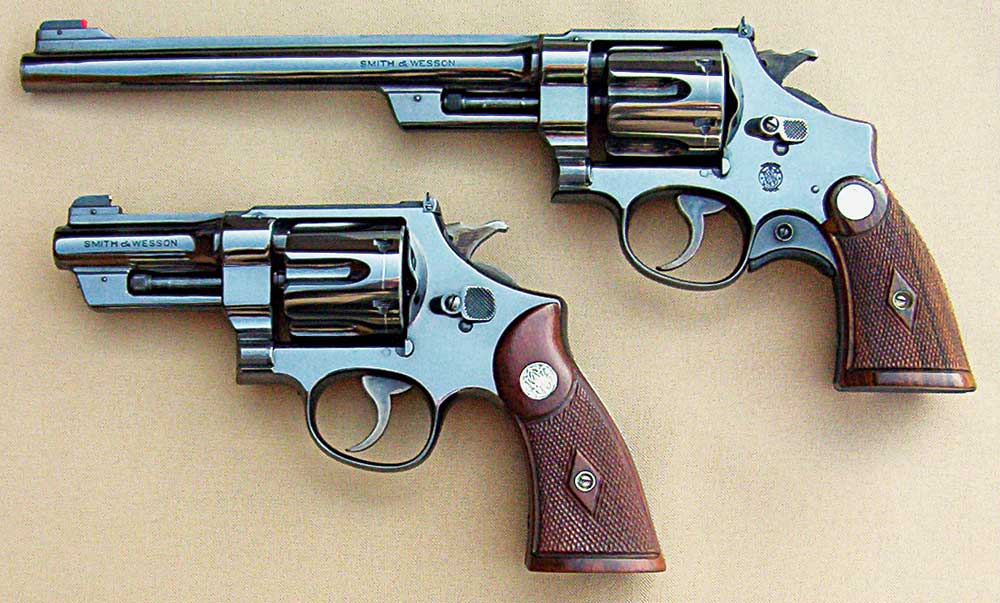
In 1935, Smith & Wesson introduced the .357 Magnum.
It represented an important step in revolver development. The new cartridge offered substantially greater performance than the standard service cartridges of the period and created a new category of powerful revolvers.
The .357 Magnum attracted attention from law enforcement, competitive shooters, and civilian gun owners.
The Magnum era had begun.
Model 29 and the .44 Magnum
If the .357 Magnum opened a new technological era, the .44 Magnum made that era famous.
In 1955, Smith & Wesson introduced its .44 Magnum revolver, which became the Model 29.
It was a large and powerful revolver that eventually became one of the company's most recognizable firearms.
At first, however, it was not a mass-market phenomenon.
That changed with Hollywood.
The Model 29 became especially famous after appearing in the 1971 film "Dirty Harry," starring Clint Eastwood. The movie turned the revolver into a cultural icon far beyond the world of shooting.
It became one of the clearest examples of how popular culture can influence the public image of a real firearm.
Smith & Wesson Moves Into Semi-Automatic Pistols
Despite its enormous revolver heritage, Smith & Wesson could not ignore the growing importance of semi-automatic pistols.
The company had experimented with semi-automatic designs as early as the beginning of the twentieth century, but the post-war period brought a much stronger focus on this category.
In 1955, Smith & Wesson introduced the Model 39, a 9mm semi-automatic pistol. It represented an important new direction for the company. Smith & Wesson - company history
This was a fundamentally different approach from the traditional revolver.
Revolvers retained their own advantages and market, but semi-automatic pistols offered detachable magazines and automatic cycling after each shot.
The market was changing, and Smith & Wesson was changing with it.
Stainless Steel and New Materials
The technological evolution was not limited to mechanisms.
Materials were changing too.
In 1965, Smith & Wesson introduced the Model 60, an important early example of the company's use of stainless steel in a production revolver.
Later, the company incorporated aluminum alloys, titanium, scandium, and other materials into various designs to reduce weight and alter performance characteristics.
In the 1970s, stainless steel continued to play a growing role in the company's products, and in 1979 Smith & Wesson introduced the Model 629, a stainless-steel .44 Magnum revolver. Smith & Wesson - historical company materials
The development of firearms was not only about new cartridges and mechanisms.
Sometimes the next major step began with the material from which the firearm itself was made.
From the Revolver to Modern Smith & Wesson
During the 1980s, Smith & Wesson continued developing the .357 Magnum platform.
The L-Frame family introduced models such as the 581, 586, 681, and 686. These revolvers became an important part of the company's later history and found applications in law enforcement as well as competitive shooting. Smith & Wesson - historical company materials
At the same time, Smith & Wesson continued developing semi-automatic pistols.
New generations of firearms eventually incorporated polymer components, modern materials, and designs that looked very different from the revolvers of the nineteenth century.
But the connection with the past remained.
Modern Smith & Wesson still produces revolvers, including designs that trace their lineage back to the company's classic revolver tradition.
Good Firearms Need Proper Care
Throughout the history of Smith & Wesson, cartridges, materials, mechanisms, and firearm designs have changed dramatically.
One thing, however, has remained the same: firearms require proper maintenance.
At Raccoon Merch, we have the Clarity Gun firearm cleaning mats.
They provide a dedicated work surface for firearm maintenance, helping keep tools and components organized while protecting the underlying surface from oil and dirt.
It is a modern part of the same basic culture of firearm care that has existed for generations: after use, a mechanical system needs attention, cleaning, and maintenance.
Smith & Wesson Today
Today, Smith & Wesson continues to manufacture both revolvers and semi-automatic pistols.
Its modern product range reflects much of the company's history at once.
There are classic revolver designs, Magnum models, compact firearms, modern materials, and semi-automatic pistols designed for the requirements of the twenty-first century.
More than 170 years after Horace Smith and Daniel Wesson began experimenting with new firearm designs, the company continues to evolve with changing technology.
From Model 1 to Magnum
The history of Smith & Wesson shows just how dramatically handguns changed over the last century and a half.
In 1857, the small Model 1 demonstrated the potential of the self-contained metallic cartridge.
Then came the large Model 3, service revolvers, the Model 10, .357 Magnum, .44 Magnum, and the famous Model 29.
Later came semi-automatic pistols, stainless steel, lightweight alloys, new materials, and modern firearm designs.
Smith & Wesson survived a fundamental change in the concept of the handgun itself.
Perhaps that is the most interesting part of the company's history: it never remained tied to a single legendary model. It repeatedly changed along with technology.
From Model 1 to Magnum, this is not simply the story of individual revolvers. It is the story of how the handgun moved from the first practical metallic cartridges into the modern era.
Clarity Gun Rubber Cleaning Mat — Instructions & Care
What to Gift a Soldier: 15 Meaningful Gift Ideas They'll Truly Appreciate
What Do Soldiers and Veterans Collect? 6 Items That Preserve the Story of Military Service
Colt: The History of the Company That Changed the World of Firearms
Glock - The History of the Company and the Pistol That Changed Modern Handguns
Beretta - The History of the World's Oldest Firearms Manufacturer
Česká zbrojovka: From a 1936 Arms Factory to the CZ BREN 2
SIG SAUER: From a Swiss Factory to One of the World's Best-Known Firearms Manufacturers
Heckler & Koch: The History of German Firearms That Became Legendary