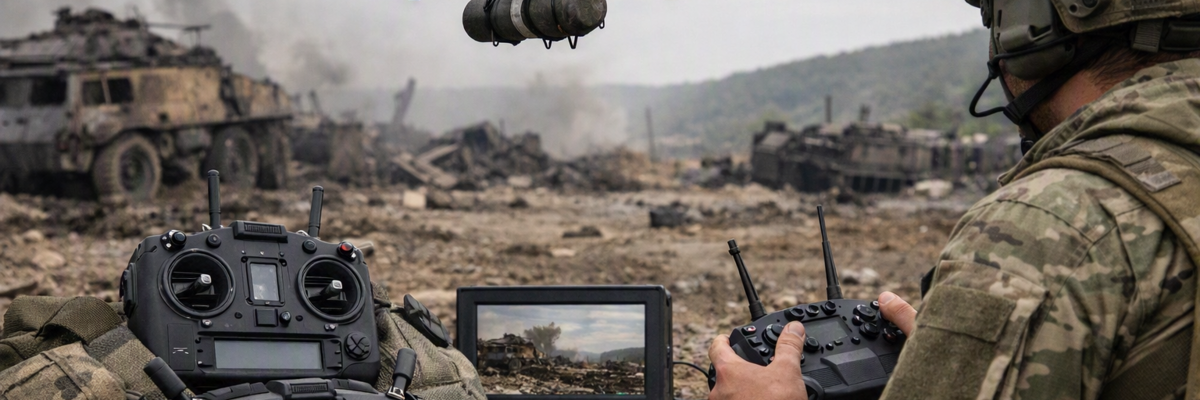
Today, First Person View (FPV) drones represent one of the primary technological forces on the frontline. Yet only a few years ago, FPV flying was merely a niche hobby for RC enthusiasts and high-speed drone racing pilots.
The transition from DIY racing kits to a weapon system that redefined 21st-century military doctrine represents the fastest technological evolution in the history of modern conflict.
When FPV Emerged and How It Joined the Battle
The acronym FPV stands for "First Person View." The technology of transmitting real-time video feeds directly to a pilot's goggles or monitor developed rapidly throughout the 2000s and 2010s. Its main playground was civilian drone racing - competitions where pilots navigated obstacles at speeds exceeding 100 km/h.
Following the full-scale invasion of Ukraine in 2022, an urgent need arose for cost-effective, high-precision strike capabilities against enemy armor and personnel. Commercial quadcopters like the DJI Mavic excels at reconnaissance and light grenade drops, but targeting moving vehicles required unprecedented speed and maneuverability.
The first isolated trials of FPV kamikaze drones by battlefield innovators began in the summer and autumn of 2022. It quickly became evident that an inexpensive drone costing a few hundred dollars could destroy heavy military equipment worth millions when operated with precision.
Stages of Evolution and Emerging FPV Variants
In just a few short years, FPV drones progressed from basic 7-inch kamikaze builds into complex, multi-component aerial and ground combat systems.
1. The First Wave: Standard Kamikazes and Light Drops
Initially, operators utilized off-the-shelf racing frames (mostly 7-inch and 10-inch configurations) equipped with improvised or military payloads, such as RPG warheads. They relied on standard analog video transmission and conventional radio frequencies.
2. The Frequency War and Air Repeaters
As electronic warfare (EW) systems proliferated across the battlefield, FPV technology adapted rapidly:
-
Frequency Shifting: Transitioning to non-standard control and video bands outside the range of typical trench EW devices.
-
Drones with Air Repeaters: Deploying secondary airborne repeaters (fixed-wing drones or larger multirotors) flying high above the battle zone to relay control and video signals. This expanded operational ranges significantly and allowed drones to strike targets behind terrain obstacles.
3. Thermal FPV and Computer Vision
The integration of thermal and low-light cameras turned FPV operations into a round-the-clock threat. Simultaneously, machine vision and AI-assisted terminal guidance emerged, enabling auto-targeting to complete strikes even when EW jamming completely sever radio links.
4. Fiber-Optic FPV: The EW-Proof Solution
One of the most notable engineering milestones was the development of spool-based fiber-optic control cable that unrolls in mid-air during flight. Free from radio transmission, fiber-optic drones are completely immune to electronic jamming, emit no RF signal to be intercepted, and deliver crystal-clear HD video feed.
5. Integration with Satellite Links
Combining FPV platforms with Starlink satellite terminals allowed operators to set up long-range ground and aerial relay systems controllable from virtually anywhere with low latency.
6. Anti-Drone Interceptors
Engineered for high speed, specialized FPV interceptors began targeting hostile reconnaissance UAVs (such as Zala, Orlan, and Supercam) directly in mid-air, offering a highly cost-effective alternative to traditional air defense missiles.
Heavy Night Bombers: "Vampire" and "Bat" Platforms
Parallel to lightweight kamikaze drones, a distinct class of heavy multirotors evolved - hexacopters and octocopters exemplified by Ukrainian platforms like the "Vampire" and "Bat".
Unlike single-use kamikazes, these reusable heavy bombers operate predominantly at night:
-
They deliver payload capacities ranging from 10 to 20 kg (heavy anti-tank mines, thermobaric charges, and HE munitions).
-
Equipped with powerful thermal optics for night operations.
-
Primarily deployed for remote minelaying, destroying ammunition depots, and clearing fortified positions.
Unmanned Ground Vehicles (UGVs): FPV Beyond the Sky
The FPV control philosophy quickly expanded beyond aviation into ground robotics. The same principles of real-time video feed and remote control now power wheeled and tracked ground platforms.
Today, ground-based FPV robots fulfill essential frontline roles:
-
Logistics and Evacuation: Transporting ammunition, supplies, and water to exposed positions, as well as evacuating wounded personnel.
-
Minelaying and Demining: Remotely deploying anti-tank mines or clearing paths through minefields.
-
Ground Kamikazes and Turrets: Explosive-laden ground drones designed to breach strongpoints or target heavy armor from the ground.
Software, Algorithms, and Simulators: Upgrading the Digital Core
The evolution of FPV is driven as much by code as by hardware. Firmware ecosystems like Betaflight and INAV, alongside protocols like ExpressLRS (ELRS), have undergone extensive military hardening. Modern setups incorporate encrypted communications, anti-spoofing measures, and automated target acquisition.
Simulators have also transformed pilot training. Flight simulation platforms allow new operators to master complex maneuvering, high-speed target approaches, and EW mitigation techniques over hundreds of virtual flight hours before handling live ordinance.
The Operator's Craft: Birth of a New Military Profession
Operating FPV drones has created a new category of military specialist. An FPV operator combines the skill sets of a pilot, engineer, gamer, and explosives technician.
Flying an FPV drone at speeds exceeding 100 km/h requires fine motor control, rapid spatial reasoning, and split-second decision-making. Operators must continuously monitor telemetry, signal strength, wind conditions, battery consumption, and EW interference while identifying critical weak spots on target vehicles.
Decentralized Innovation as an Evolutionary Engine
The explosive pace of FPV development stems largely from a decentralized production ecosystem. Thousands of private teams, engineering startups, volunteer workshops, and defense enterprises continuously develop and refine FPV systems.
This intense environment accelerates technical iteration:
-
Custom frame designs, smart initiation boards, and safety mechanisms are introduced weekly.
-
Advanced digital and analog radio protocols are constantly integrated.
-
Standardized assembly line methods and strict quality control processes are routinely adopted.
This flexibility allows small engineering teams to adapt far faster than traditional defense procurement cycles.
The Unmanned Systems Forces (USF)
The scale and strategic impact of drone warfare led to a historic milestone: in 2024, Ukraine became the first nation in the world to establish a dedicated military branch - the Unmanned Systems Forces (USF).
This decision officially recognized unmanned technologies not merely as auxiliary equipment, but as a primary doctrine shaping the future of modern warfare.
FPV Culture and Identity
The rise of FPV technology has inspired its own unique culture, complete with distinct terminology, humor, and symbols. Insignia featuring FPV drones, propellers, and specialized military emblems have become iconic markers of modern technological warfare.
At Raccoon Merch, we honor this community by creating comfortable t-shirts, cozy hoodies, custom PVC patches, and detailed silver jewelry inspired by FPV operators and military themes. Our gear offers a way to wear your passion and connect with the community driving this technological era forward.
Conclusion
The evolution of FPV on the frontline continues every day. The ongoing dynamic between frequencies, artificial intelligence, fiber optics, and tactics ensures that technology adapts continuously. What began as an agile racing hobby stands today as a cornerstone of modern defense.
What to Give an FPV Pilot - Gift Ideas for an FPV Drone Pilot
What to Give a Commander or Officer - Gift Ideas for a Military Service Member
What to Give a Military Medic: 17 Gift Ideas for Combat Medics, Paramedics and Tactical Medics
The History of Military Dog Tags: From Identification to a Symbol of Military Service
What to Gift a Soldier: 15 Meaningful Gift Ideas They'll Truly Appreciate